
























 BACK TO LIST
The Earl of Buckingham’s Royal Wine Coolers
The Earl of Buckingham’s Wine Coolers
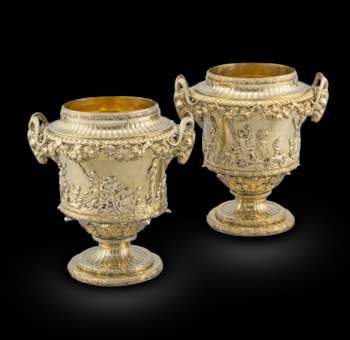
A pair of royal George III silver wine coolers,
London, 1763
Maker’s mark of John Parker & Edward Wakelin
Height: 26 cm, 10¼in. , Weight: 6875gr., 221oz
As early as the 16th century, silver in Britain was not only a measure of wealth but also a tool of diplomacy and cultural display. The ambassadorial services were a strategic and symbolic tool in British diplomacy, combining artistry, wealth, and ceremonial function that reinforced the prestige of the Crown and its emissaries abroad.
Our ambassadors were expected to entertain in a manner that reflected the dignity and power of the English crown. To achieve this, the Jewel Office, a division of the royal household responsible for precious metals, issued silver services to officials posted at foreign courts. These services included elaborate dinnerware such as tureens, sauceboats, serving dishes, and cutlery, often designed to accommodate large gatherings of thirty-six guests or more.
Serving far more than just their obvious function, the Ambassadorial services were expressions of taste, education, and sophistication. The silversmiths produced highly detailed and technically sophisticated pieces. Their work featured die-stamped borders, intricate engraving, and animated grotesques, reflecting both artistic skill and the prestige of the Crown. The silver was sometimes displayed on buffets to impress foreign dignitaries, with royal arms prominently engraved or cast to signify the ambassador’s official status.
When sending an ambassador abroad. They would receive diplomatic pay and expenses, and the material objects with which they were furnished in their role as the king’s representative. These comprised large quantities of silver plate from the Jewel House and a chair of state and canopy from the Great Wardrobe; diplomats were also provided with allowances for commissioning the monarch’s portrait and gala coaches for their formal entry. During the fifty years after 1660 a notable evolution occurred in which diplomats played a greater personal role in the fashioning of their royal perquisites, and during which the dictates of elite fashion affected the way they looked and the goldsmiths, joiners, and craftsmen who were employed. By 1714 an ambassador’s official environment had become as much a reflection of his own tastes as those of diplomatic precedence.
These magnificent Royal wine coolers achieve this with a gusto with their inverted baluster form. Their bases are applied with grapes and olive branches and their bodies partly fluted. Of course, applied with George III’s royal arms on both sides, with floral swags leading to the grape vine handles, the gadrooned rims centred with shells. Each wine cooler also with inventory numbers and scratch weights engraved "N°1, 110=4” and “N°2, 113=7.
A pair of royal George III silver wine coolers,
London, 1763
Maker’s mark of John Parker & Edward Wakelin
Height: 26 cm, 10¼in. , Weight: 6875gr., 221oz
As early as the 16th century, silver in Britain was not only a measure of wealth but also a tool of diplomacy and cultural display. The ambassadorial services were a strategic and symbolic tool in British diplomacy, combining artistry, wealth, and ceremonial function that reinforced the prestige of the Crown and its emissaries abroad.
Our ambassadors were expected to entertain in a manner that reflected the dignity and power of the English crown. To achieve this, the Jewel Office, a division of the royal household responsible for precious metals, issued silver services to officials posted at foreign courts. These services included elaborate dinnerware such as tureens, sauceboats, serving dishes, and cutlery, often designed to accommodate large gatherings of thirty-six guests or more.
Serving far more than just their obvious function, the Ambassadorial services were expressions of taste, education, and sophistication. The silversmiths produced highly detailed and technically sophisticated pieces. Their work featured die-stamped borders, intricate engraving, and animated grotesques, reflecting both artistic skill and the prestige of the Crown. The silver was sometimes displayed on buffets to impress foreign dignitaries, with royal arms prominently engraved or cast to signify the ambassador’s official status.
When sending an ambassador abroad. They would receive diplomatic pay and expenses, and the material objects with which they were furnished in their role as the king’s representative. These comprised large quantities of silver plate from the Jewel House and a chair of state and canopy from the Great Wardrobe; diplomats were also provided with allowances for commissioning the monarch’s portrait and gala coaches for their formal entry. During the fifty years after 1660 a notable evolution occurred in which diplomats played a greater personal role in the fashioning of their royal perquisites, and during which the dictates of elite fashion affected the way they looked and the goldsmiths, joiners, and craftsmen who were employed. By 1714 an ambassador’s official environment had become as much a reflection of his own tastes as those of diplomatic precedence.
These magnificent Royal wine coolers achieve this with a gusto with their inverted baluster form. Their bases are applied with grapes and olive branches and their bodies partly fluted. Of course, applied with George III’s royal arms on both sides, with floral swags leading to the grape vine handles, the gadrooned rims centred with shells. Each wine cooler also with inventory numbers and scratch weights engraved "N°1, 110=4” and “N°2, 113=7.
