























 BACK TO LIST
Directors Choice – The Victorian Novelty Claret Jug
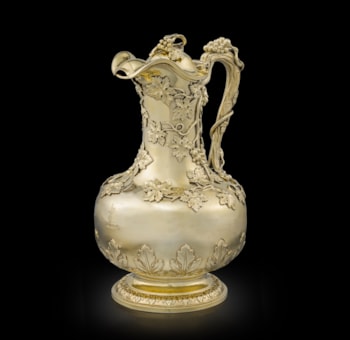
A Victorian silver mounted ‘Duck Claret Jug’ made in London, 1881,
By William Lechars. The patent registration kite mark for 15th January 1881
Perhaps due to the deep-rooted desire of Western culture to tame all that was foreign, atypical and unknown, the fascination with the exotic exploded in the Victorian era. Wild tigers were displayed caged in zoos, children could pose at the museum with ferocious taxidermied bears, and African elephants were mounted in parades through the streets with travelling menageries. In this Victorian landscape of eccentric excesses, animals functioned as human properties, the existence of which reflected the status and the capricious fantasies of their human owners. Collectors’ interest in exotic animals exploded as they became more accessible to the general public. Sir Stamford Raffles established the London Zoo in 1826. However, he died the following year of a stroke. On his death, the third Marquis of Lansdowne took charge of the project and organised the construction of the first structures to house the animals. In 1829 King George IV issued a Royal Decree-Law in favour of the Zoological Society, and in 1847 the zoo officially opened to the public. The zoo opened the first Reptile House in 1849 and Aquarium in 1853. The appearance of live exotic animals combined with the publication of Illustrated Books such as the Monkeyana - a collection of 24 etched plates of anthropomorphic monkeys published in 1827 by Thomas Landseer - or Tenniel’s illustrations of Alice in Wonderland (1865) indeed moved the artists to incorporate exotic animals in their models. The silversmiths’ naturalistic approach consisted of reproducing nature as faithfully as possible: the artist aims to represent objective reality, avoiding any stylisation or abstraction. This approach is evident in creating the zoomorphic claret jugs, in which silversmiths not only portrayed animals in detail but approached their reproduction scientifically
My Director’s Choice this week highlights the competitive, often difficult environment the Victorian silversmith, designer and retailer found themselves in at the end of the 19th century. It also highlights the success of the novel by Lewis Carol and how it gripped the nation and drove fashion at the same time.
