


















Paul de Lamerie
( 1688 - 1751 )
The Janssen Candlesticks

Paul de Lamerie
( 1688 - 1751 )
The Janssen Candlesticks

The Janssen Candlesticks
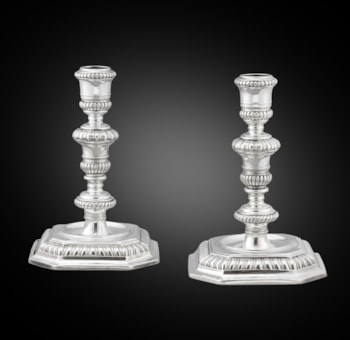
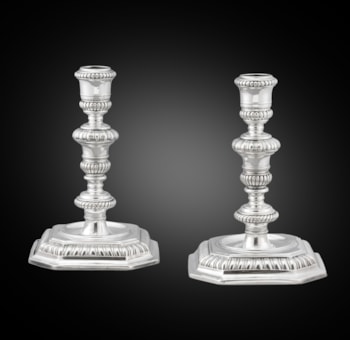
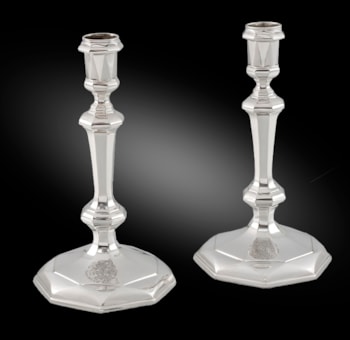
A Pair of George II Silver Candlesticks, Paul de Lamerie, London, 1737
Weight: 1,424g, 45 oz 15 dwt
Height: 20.5 cm, 8 1/4 in.
The candlesticks with shaped square bases and baluster stems all decorated and applied with rococo ornament, the base with a stemmed flower crest repeated four times.
The flower crest is that of Janssen, a family noted for their connoisseurship of silver. The likely patron for the original set of four candlesticks is Sir Theodore Janssen (1658-1748), a Dutch merchant who arrived England c. 1680 and was a founder and director of the Bank of England. Created a baronet in 1714, he was a noted financier supposedly worth 300,000 pounds. Implicated in the South Sea Bubble scandal, he was heavily fined by the House of Commons committee in 1721. His son Stephen Theodore Janssen was also based in London and may also have commissioned these, but sons Robert and Henry moved to Paris, where the latter is believed to have been the original patron of the important silver by Thomas Germain and others known to history as the Penthièvre-Orléans Service.
The matching candlesticks from the original set of four were sold Christie's New York, 19th October 2004, lot 1062. A set of four salts by Lamerie engraved with the same crest are in the Farrer Collection at the Ashmolean Museum (Illus. Susan Hare, Paul de Lamerie, no. 78, p.122).
The earliest examples of this Lamerie design were for Sir Robert Walpole in 1731, and support unmarked four-light tops (Schroder, The Gilbert Collection of Gold and Silver, 1988, pp. 204-206, cat. no. 50). Six candlesticks with two candelabrum branches of 1737 are at Woburn Abbey. Two sets of four sticks of 1737 and 1738 are in the Clark Art Institute (Wees, English, Irish, and Scottish Silver at the Sterling and Francine Clark Art Institute, 1997, cat. no. 375 and 376, with a note on the known versions of the model).
Sotheby's, London, 6th November 1997, lot 163
The Chen Collection, sold
Lyon & Turnbull, Edinburgh, 23 November 2008, lot 206
Paul de Lamerie arrived in England with his Huguenot parents in or before 1689, having been baptized at 's Hertogenbosch in the Netherlands in 1688. In 1703 he was apprenticed to the Huguenot goldsmith Pierre Platel, and after being admitted to the freedom of the Goldsmiths' Company, he registered his first mark and set up a workshop in Windmill Street, Soho, in 1712. He took thirteen apprentices between 1715 and 1749 who paid premiums varying between £10 and £45m In 1716 he married Louisa Juliott, also a Huguenot, and by her had six children, three of whom died in childhood. Little more of his personal history is known, although his career in the Goldsmiths' Company is comparatively well documented. By 1717, he was already referred to as 'the King's Silversmith' but again in a complaint 'for making and selling Great quantities of Large Plate which he doth not bring to Goldsmith's Hall to be mark't according to Law.' He joined the livery in 1717; fourteen years later he was elected to the court of assistants. In 1743 he was appointed fourth warden and in 1747 second warden; that he never became prime warden probably due to ill health. From the outset he had wealthy clients such as the Honourable George Treby and the Duke of Sutherland. Among his more important later patrons were Sir Robert Walpole, Baron Anson, and the fifth Earl of Mountrath. A gradual expansion of his business culminated in his move in 1739 to considerably larger premises in Gerrard street. His pre-eminent position in the trade is signified by the commission he received in 1740 from the Goldsmiths' Company to provide two of their most splendid pieces of ceremonial display plate, a silver-gilt inkstand and the famous rococo ewer and dish.
You May Also Like

The Duke of Roxburghe’s Tureen
John Samuel Hunt

A George II Soup-Tureen & Cover
Paul de Lamerie

A pair of 1970s French gold and diamond leaf ear clips
Tiffany & Co.

A pair of Monumental silver Warwick vases
William Comyns