


















Digby Scott & Benjamin Smith
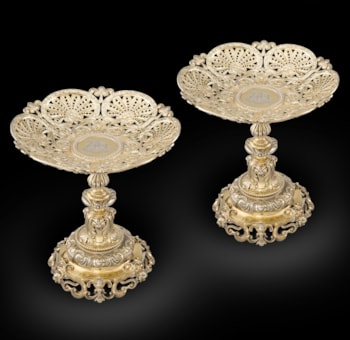
A set of Four George III Royal silver-gilt coasters

Digby Scott & Benjamin Smith
A set of Four George III Royal silver-gilt coasters

By Digby Scott & Benjamin Smith
London, 1805/1806
13.5cm, 5½in.
the sides pierced and chased with fruiting vines, the silver base plates engraved with royal ducal armorials, stamped for Rundell, Bridge & Rundell, and further engraved EAFs on the rims.
The arms are those for Ernest Augustus, 1st Duke of Cumberland and later King of Hanover (1771-1851).
Benjamin Smith and Digby Scott began to produce wine coasters in various similar fruiting vine patterns in 1803. An 1804 set of four wine coasters in one of these patterns, is engraved with the badge of the Duke of Cumberland's brother the Duke of Sussex and illustrated in The Glory of the Goldsmith: Magnificent Gold and Silver from the Al Tajir Collection, 1989, fig. 116, p. 154.
It was reported in June 1923 that the Duke of Cumberland was negotiating with several groups of dealers, ‘each of them as quietly as possible, for even part of the collection would be regarded as a great prize.’1 This prize was to be won by the London silver dealer Lionel Alfred Crichton (né Lionel Alfred Solomon, 1865-1938), and with the English part of the Hanover/Cumberland silver secured, Crichton opened their first selling exhibition on 20 November 1923, which, coincidentally, was just a week after Cumberland’s death.2 The exhibition was such a success, Crichton purchased another tranche of silver from Hanover for an exhibition stage the following year.
Notes
1. The Times, London, Thursday, 21 June 1923, p. 13g
2. The Times, London, Tuesday, 20 November 1923, p. 11b
Ernest Augustus, 1st Duke of Cumberland and Teviotdale, from 1837 King of Hanover (1771-1851), and by descent to
Ernest Augustus, Crown Prince of Hanover, 3rd Duke of Cumberland and Teviotdale (1845-1923), sold to
Crichton Brothers in 1923 and subsequently purchased by either Urban Huddleston Broughton, 1st Lord Fairhaven (1896–1966) or his brother
Henry Rogers Broughton, 2nd Lord Fairhaven (1900-1973), both at that time of Anglesey Abbey, Cambridgeshire,
thence by descent
H. Avray Tipping; The English Silver Plate of the Duke of Cumberland; Country Life; 2 February 1924, p.162
The partnership of Digby Scott and Benjamin Smith produced some of the greatest silver works of the early 19th century. Scott and Smith jointly ran workshops located in Greenwich, England from 1802 to 1807 and during their brief partnership were the principal suppliers of silver masterpieces to the esteemed firm of Rundell, Bridge & Rundell. At the time London's most prestigious firm, these jewellers and silversmiths supplied the official plate ordered by the Lord Chamberlain's office, and were the official "Jeweller, Gold and Silversmiths to the Crown" from 1798 to 1843. Working in the cusp of the late Georgian and early Regency periods, the works of Scott and Smith often feature elements of the classical revival style such as grapevines and rams' heads, all crafted in exquisite, sumptuous detail. One of their most renowned collaborative efforts, the Duke of York Baskets, created for Frederick Augustus (1763-1827), second son of George III, is currently on display at the Powerhouse Museum in Australia.
You May Also Like

A George III 18 Carat Gold Snuff Box
Alexander Strachan

The Duke of Roxburghe’s Tureen
John Samuel Hunt

The Robert Troup Tray
Benjamin Smith II & James Smith III

A pair of 1970s French gold and diamond leaf ear clips
Tiffany & Co.