

















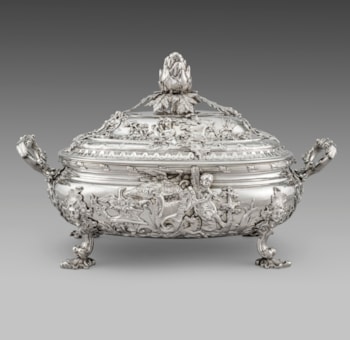







Nicholas Sprimont
( 1716 - 1771 )
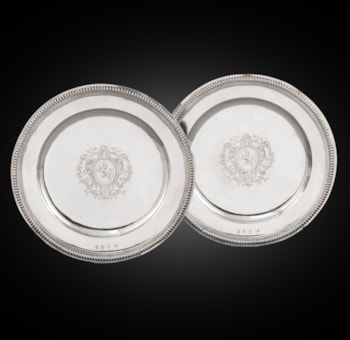
The Jervoise Serving Dishes

Nicholas Sprimont
( 1716 - 1771 )
The Jervoise Serving Dishes

A Suite of George II Serving Dishes
London, 1743
Maker’s mark of Nicholas Sprimont
Diameter of Largest: 37.5 cm, 14 3/4 in.
Total Weight: 5,685 g, 182 oz 15 dwt
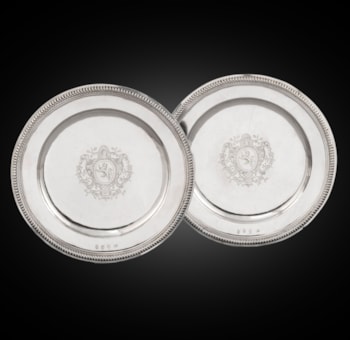
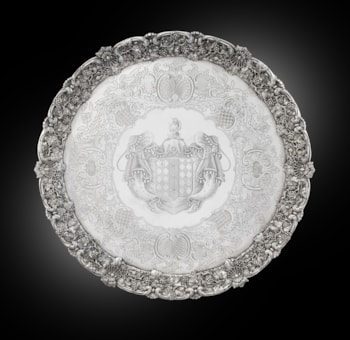
The suite compring of two circular dishes (11 1/4 in.), two large circular dishes (14 3/4 in.) and two oval dishes (13 3/4 in.), all with reeded rims with leaves, shells and cartouches at intervals, engraved with the coat-of-arms of Jervoise family.
The dishes engraved on bases, two large No. 14 / 44=18 and No. 13 / 44=7, two smaller No. 1 / 25=9 and No. 4 / 26=5, two oval No. 8 / 26=15 and No. 7 / 25=19
Tristam Hudleston Jervoise (1736-1794) of Herriard Park, Hampshire, or his brother the Rev. George Hudleston Jervoise Purrefoy Jervoice (d. 1805), thence by descent to:
Major A.F. Clarke Jervoise D.L., J.P., Idsworth Park, Horndean, Hampshire, sold
Christie's, London, 11 December 1968, lots 177 and 178 (circular dishes)
Christie's, London, 1 December 2004, lot 663 (circular dishes)
Christie's London, 26 March 1975, part of lot 180 (oval dishes)
H R Jessop Ltd, London (oval dishes)
Son of Peter Sprimont and Getrude Goffin, born at Liège, 23 January 1716. Apprenticed as silversmith to his uncle and godfather Nicholas Joseph Sprimont at Rue du Pont 16. He arrived in England probably early in 1742 as he married, 13 November that year, at Knightsbridge Chapel, Ann Protin of Kensington, spinster. His only hallmark entered as a largeworker, 25 January 1743. His address recorded at Compton Street, St. Ann's, Soho. The rate books show him as tenant of a house on the north side of Compton Street and two years later with an additional back-shop. He remained in occupation here until 1748. He also appears from 1747 in the Chelsea rate book as occupying half of Monmouth House in Lawrence Street, and from then onwards it seems clear that the new venture of porcelain manufacture was to absorb his full interest and time (F. Severne Mackenna, Chelsea Porcelain, 1948, based on the research of Major W. H. Tapp).
After the sale of the Chelsea business to Duesbury of Derby, James Christie sold the remaining Chelsea productions which Sprimont appears to have retained as his own property. He remained living in Chelsea and Richmond till his death later that year at the early age of fifty-four, since Christie's catalogue of his picture collection, sold 26-27 March 1771, describes them as brought from his houses in these two places. The pictures of the Italian, French, Flemish and Dutch schools in 173 lots realized the high total for the time of £1,239.
Sprimont is buried in Petersham Church below Richmond Hill. His surviving hallmarked pieces of silver are excessively rare, and all lie between 1742 and 1747. The best known are the two pairs of marine salts of 1742, the dishes of 1743, and sauceboats of 1743 -4, all in the Royal Collection. His largest pieces known are a jardinière of 1745 (Christie's, 15 February 1905 and Rovensky Collection, Parke-Bernet, 19 January 1957) and the Ashburnham centrepiece or covered basket of 1747 (Christie's, 24 March 1914, now Victoria and Albert Museum). Another important item is the tea kettle of 1745 in the Russian Royal Collection (E.A Jones, The Old English Plate of the Emperor of Russia, Plate XLIX).
For a really in-depth insight into the life of Nicholas Sprimont please see Tessa Murdoch’s recent book Europe Divided, Huguenot Refugee Art & Culture pages 42, 112, 153, 162-70, 202-3
You May Also Like
An Elegant Pair of William III Plates
Thomas Parr I

A set of twenty-four silver underplates
C.J. Vanders

The Templeton Soup Plates
Hunt & Mortimer