























Paul Storr
( 1771 - 1844 )
Charles Anderson Pelham, 1st Baron Yarborough’s Tea & Coffee Service

Paul Storr
( 1771 - 1844 )
Charles Anderson Pelham, 1st Baron Yarborough’s Tea & Coffee Service

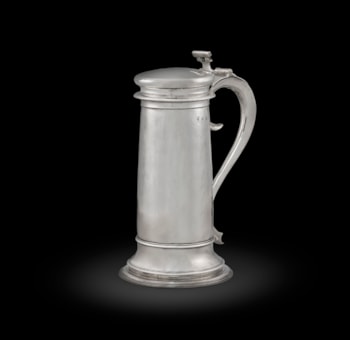
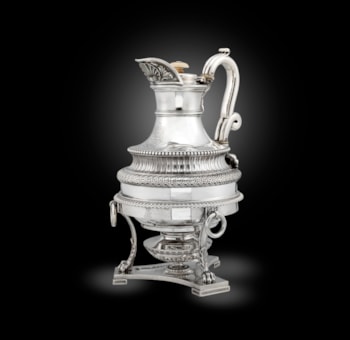
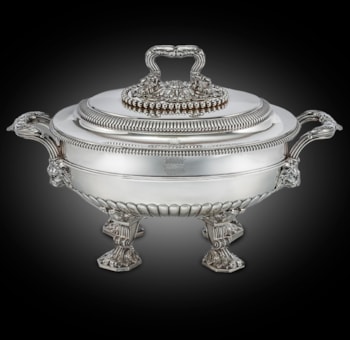
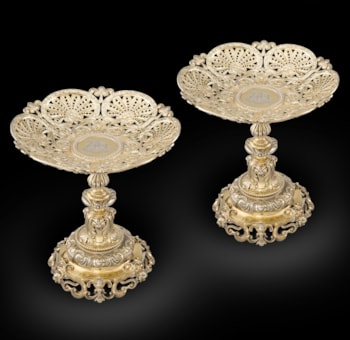
A George III Silver-Gilt Four-Piece Tea & Coffee Service
London, 1808-9
Maker’s mark of Paul Storr
Weight: 4,261 g, 137 oz
Height of coffeepot on stand: 28 cm, 11 in
The service comprising of a teapot, sugar Bowl, creamer, and coffee pot on stand. Each piece with bands of anthemion on matted ground and with snake-form handles or handle mounts, the teapot and kettle engraved with arms, supporters, and motto, the teapot, burner, creamer and sugar bowl crested, marked throughout.
The arms are those of Anderson-Pelham.
Charles Anderson-Pelham, 1st Baron Yarborough FRS FSA (3 February 1749 – 22 September 1823) was a British politician.
Anderson-Pelham was born Charles Anderson in Broughton, Lincolnshire, the eldest son and heir of Francis Anderson and his wife Eleanor (née Carter) Anderson. His father died in 1758 and in 1763, he succeeded to the estates of his great-uncle Charles Pelham and assumed the additional surname of Pelham. In 1768, his mother remarried to Robert Vyner of Gautby, Lincolnshire, who was an MP. From his mother's second marriage, he had a younger half-brother, Robert Vyner.
His paternal grandparents were Francis Anderson, of Manby and Mary (née Pelham) Anderson. His maternal grandfather was Thomas Carter of Basavern, Denbigh and his uncle was the Rev. Robert Carter–Thelwall (whose daughter, Charlotte Thelwall, was the first wife of William Beauclerk, 8th Duke of St Albans).
Anderson entered Eton with his younger brother, Francis Evelyn Anderson, in 1763, the same year he assumed the surname Pelham. In 1789, he served as steward of the Eton anniversary.
Anderson-Pelham was elected to the House of Commons for Beverley in 1768, a seat he held until 1774, and then represented Lincolnshire until 1794. The latter year he was raised to the peerage as Baron Yarborough, of Yarborough in the County of Lincoln. After being elevated to the House of Lords, his seat in the House of Commons was taken by his younger half-brother, Robert Vyner.
He was appointed High Sheriff of Lincolnshire for 1771. The same year, he commissioned a marble statue of Mars from John Bacon, which he exhibited in his residence. He was elected a Fellow of the Royal Society in 1777 and a Fellow of the Society of Antiquaries in 1796. On 21 July 1770, Charles was married to Sophie Aufrere, daughter and heir of George Aufrere of Chelsea.
The Collection of Mrs. Fay Plohn, New York, sold
Sotheby's London, 16 July 1970, lot 136
Son of Thomas Storr of Westminster, first silver-chaser later innkeeper, born 1771. Apprenticed c'1785. Before his first partnership with William Frisbee in 1792 he worked at Church Street, Soho, which was the address of Andrew Fogelberg. This is also the address at which Storr's first separate mark is also entered. First mark entered as plateworker, in partnership with William Frisbee, 2 May 1792. Address: 5 Cock Lane, Snow Hill. Second mark alone, 12 January 1793. Address: 30 Church Street, Soho. Third mark, 27 April 1793. Fourth 8 August 1794. Moved to 20 Air Street, 8 October 1796, (where Thomas Pitts had worked till 1793). Fifth mark, 29 November 1799. Sixth, 21 August 1807. Address 53 Dean Street, Soho. Seventh, 10 February 1808. Ninth, 21 October 1813. Tenth, 12 September 1817. Moved to Harrison Street, Gray's Inn Road, 4 March 1819, after severing his connection with Rundell, Bridge and Rundell. Eleventh mark, 2 September 1883. Address: 17 Harrison Street. Twelfth and last mark, 2 September 1833. Heal records him in partnership with Frisbee and alone at Cock Lane in 1792, and at the other addresses and dates above, except Harrison Street. Storr married in 1801, Elizabeth Susanna Beyer of the Saxon family of piano and organ builders of Compton Street, by whom he had ten children. He retired in 1838, to live in Hill House in Tooting. He died 18 March 1844 and is buried in Tooting Churchyard. His will, proved 3 April 1844, shows an estate of £3000. A memorial to him in Otely Church, Suffolk was put up by his son Francis the then incumbent of the parish. For full details of Storr's relationship with Rundell, Bridge and Rundell please see N.M. Penzer, 1954 or Royal Goldsmiths, The Art of Rundell and Bridge, 2005.
Storr's reputation rests on his mastery of the grandoise neo-Classical style developed in the Regency period. His early pieces up to about 1800 show restrained taste, although by 1797 he had produced the remarkable gold font for the Duke of Portland. Here, however the modelling of the classical figures must presumably have been the work of a professional sculptor, as yet unidentified, and many of the pieces produced by him for Rundell and Bridge in the Royal Collection must have sprung from designs commissioned by that firm rather than from his own invention. On the other hand, they still existed in his Harrison Street workshop, until destroyed in World War II, a group of Piranesi engravings of classical vases and monuments bearing his signature, presumably used as source material for designs. The massiveness of the best of his compositions is well shown in the fine urn of 1800 at Woborn Abbey, but the Theocritus Cup in the Royal Collection must be essentially ascribed to the restraint of its designer John Flaxman, while not denying to Storr its superb execution. Lord Spencer's ice pails of 1817 show similar quality. Not all Storr's work however was of classical inspiration. The candelabra of 1807 at Woburn derive from candlesticks by Paul Crespin of the George II period, formerly part of the Bedford Collection, and he attempted essays in floral rococo design from time to time, which tend to over-floridity. On occasions the excellence of his technical qualities was marred by a lack of good proportions, as in the chalices of the church plate of St Pancras, 1821. In spite of these small lapses there is no doubt that Storr rose to the demands made upon him as the author of more fine display plate than any other English goldsmith, including Paul De Lamerie, was ever called upon to produce.
You May Also Like

A Set of Four George II Candlesticks
John Cafe

An Exceptional George III Five-Piece Tea and Coffee Set
Paul Storr

An Early 19th century oval diamond cluster link collar necklace, circa 1820

An early 20th century natural seed pearl and diamond necklace