
























Charles Thomas & George Fox
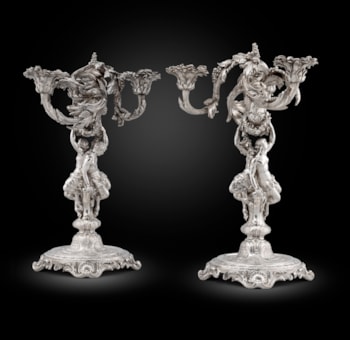
A Pair of Victorian Figural Candlesticks

Charles Thomas & George Fox
A Pair of Victorian Figural Candlesticks
London, 1853
Maker’s mark of Charles Thomas Fox & George Fox
Height: 20 cm, 7.9 in
Weight: 886 g, 28 oz 10 dwt
Each candlestick on a domed circular base, cast and chased with rocaille and scrolls and with a vacant cartouche on one side. The stems cast as a figure of a maiden with a watering can on one, and the figure of a young man with a basket of flowers on the other. Each resting against a scroll stem which rises to a leaf-cast socket. The figure are heavily influenced by the Meissen porcelain figures of the century before.
Phillips, London, 26 April 1996, lot 366
On the retirement of Charles Fox II the family business was taken over by his sons Charles Thomas Fox (born 1801) and George Fox (born 1816). They entered conjoined marks in 1841 and 1843. Charles Thomas Fox retired from the firm in 1860 and George Fox continued running the firm entering his own mark in 1861. Other marks were entered in 1869 and 1891. After the death of George Fox his son Robert Frederick Fox (born 1845) continued the trade as C.T. & G Fox entering his own mark in 1910. The firm closed down in 1921.
The firm of C.T. & G. Fox was established probably in 1801 as Turner & Fox; it was run by Charles Thomas Fox (c. 1801-72) and George Fox (c.1816-1910) from 1841. C.T. Fox retired at the end of December 1860, leaving George Fox as sole partner.
C.T. & G. Fox are known for their 'novelty' silverwares, often copying historical models.
Interestingly George Fox had worked as a shopman or salesman for Rundell Bridge & Rundell for thirty-seven years and kept a personal history of the firm. No doubt having learned so much from this great retail firm, it must have stood the Fox’s in good stead when starting their own business
You May Also Like
A Pierced Gallery Tray
Mappin & Webb
A Pair of Victorian Jugs
Hunt & Roskell

A Victorian Novelty Egg-Form Double Tea Caddy
George Fox

A Set of Four George II Silver Candlesticks
William Kidney