
























John Samuel Hunt
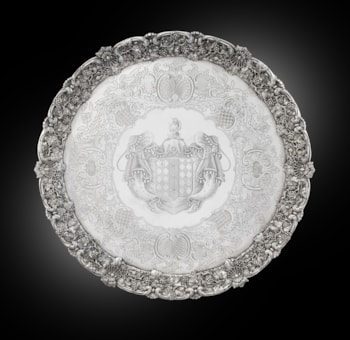
A Victorian Two-Handled Tray

John Samuel Hunt
A Victorian Two-Handled Tray

29 in. (74 cm.) wide over the handles
196 oz. 18 dwt. (6,125 gr.)
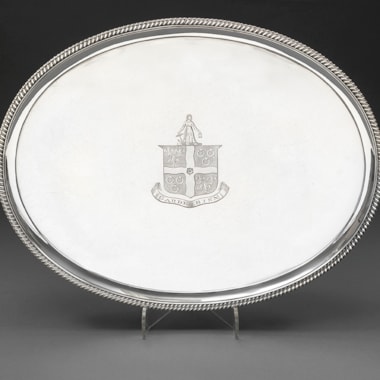
Tray in Octafoil form, with raised lobed border and ribbon-tied reed edge, the centre engraved with scrolling foliage framing a coat-of-arms and a presentation inscription.
Michael Seymour was the third son of Admiral Sir Michael Seymour, 1st Baronet (1768-1834). He entered the Royal Navy in 1813, making lieutenant in 1822, commander in 1824 and captain in 1826. On 19 February 1856 he was appointed commander-in-chief of the East Indies and China Station. On HMS Calcutta, he conducted operations arising from the attack on the British coaster Arrow. He went on to command the Battle of the Bogue in November 1856, helped destroy the Chinese fleet in the Battle of Fatshan Creek in June 1857, captured Canton in December, and in 1858 he captured the forts on the Baihe (Hai River), compelling the Chinese government to consent to the Treaty of Tientsin. He was made GCB in 1859.
This tray commemorates his contribution in the Arrow War in China and was given to him by the merchants of Hong Kong who subscribed 2000 guineas for him to have various pieces of silver made by the London firm Hunt and Roskell.
John Samuel Hunt, nephew of Paul Storr, worked for Storr for many years as a Chaser. In 1826 Hunt became a partner in of the well-known firm of Storr & Mortimer. Following Paul Storr’s retirement in December 1838
Hunt & Roskell was a renowned jewellers and silversmiths on Bond Street in London who for many years held the Royal Warrant of Queen Victoria. The firm was the successor to the celebrated silversmith Paul Storr who had left Rundell, Bridge & Rundell to set up his own workshop on Harrison Street near Clerkenwell in 1819.
A couple of years later he went into partnership with John Mortimer and began trading from 13 New Bond Street as Storr & Mortimer. In 1826 they took an additional partner, John Samuel Hunt, who brought a welcome investment capital of £5,000 with him. The firm was increasingly successful and in 1838 they moved to new premises at 156 New Bond Street settling in just prior to the retirement of Paul Storr at the end of December that same year. This prompted a name change to Mortimer and Hunt which the business operated under from 1839 until 1843 when John Mortimer retired and the name changed one again, this time to Hunt & Roskell. At this time the partners were John Samuel Hunt, his son John Hunt, Robert Roskell Jn. (son of the respected pocket watch maker Robert Roskell from Liverpool) and Charles Frederick Hancock.
The firm now entered a period of growth and prosperity. They were creating wonderful pieces of silverware from tea and coffee pots, salvers and candelabra through to presentation plates and cups as well as ornate and decorative table centre pieces. Their jewellery was equally impressive with diamond tiaras that converted into brooches and hair combs or perhaps a necklace, nestled in display cases next to bracelets set with oval portrait diamonds waiting to be fitted with a client’s choice of miniatures.
They exhibited at the Great Exhibition held in 1851 at the Crystal Palace in London’s Hyde Park where they were noted for the splendour of their display, reputedly worth a total of £100,000. By this time, they had already been granted the Royal Warrant by Queen Victoria, an honour they reflected in their maker’s mark which they surmounted with a crown. Further exhibitions followed both at home and abroad including New York in 1853 and Paris in 1867. The visit to New York was not the first time the company had ventured State side, however. In 1839 they had briefly established a branch in New York under the name Storr & Mortimer, however for reasons unclear it only operated for a couple of years, closing in 1841.
By the 1860’s they were reported to be employing 35 people at the New Bond Street shop and a further 80-100 at the factory on Harrison Street. In addition to their full time employees, they also worked in collaboration with a large number of additional craftspeople as well as retailing both jewellery and silver from other workshops such as that of Carlo Giuliano and Robert Hennell.
The business continued prosperously, and both Robert Roskell’s son Allan and John Hunt’s son John Mortimer Hunt joined their fathers in the firm. After the death of John Hunt in 1879, his son and the two Messrs Roskells continued in partnership until 1888 when Robert Roskell passed away leaving Allan Roskell and John Mortimer Hunt to run the business between them. The following year in 1889 the two men decided to dissolve their partnership and sell the business. It was acquired by J.W. Benson of Ludgate Hill who kept the name and continued trading under Hunt & Roskell until 1897 when it was converted into a limited company and styled Hunt & Roskell Ltd. which is how it remained until trading ceased towards the end of the 1960s.
Hunt & Roskell, a firm of manufacturing and retail jewellers and silversmiths, was founded by Paul Storr in 1819, trading as Storr & Co. (1819-22), Storr & Mortimer (1822-38), Mortimer & Hunt (1838-43) and then Hunt & Roskell (1843-97). Hunt & Roskell had retail premises at 156 New Bond Street and a manufactory at 26 Harrison Street, near Clerkenwell. John Samuel Hunt, who had assisted Storr from the start, continued as a partner until his death in 1865, when he was succeeded by his son, John Hunt (d.1879). Robert Roskell, formerly a watchmaker and merchant of Liverpool, joined in 1844 and remained in the firm until his death in 1888. In 1889 the firm was taken over by J.W. Benson and continued in business as Hunt & Roskell Ltd until c.1965. Trade card in Heal Collection (Heal,67.383) advertises "Hunt & Roskell, Late Storr & Mortimer, Jewellers, Goldsmiths & Silversmiths to The Queen, The Emperor of the French, &c. &c. &c..." Heal's annotations on mount: "Britten's 'Clock & Watchmakers' gives: - Storr & Mortimer, 13, New Bond St. 1830-42. 1826-7 L. Directory gives: - Paul Storr, silversmith, 13, New Bond St. 1827 L. Directory gives: - Storr & Mortimer, gold & silversmiths, 13 New Bond St. 1832 L. Directory gives: - Storr & Mortimer, jewellers, 13 New Bond St. 1838 L. Directory gives: - Storr & Mortimer, silversmiths, 13 New Bond St. 1839 L. Directory gives: - Storr & Mortimer, silversmiths, manufactory, 13 Harrison St. 136 New Bond Street and manufactory, 26 Harrison Street, Gray's Inn Road."
You May Also Like
A Silver-Gilt Tazza
Anthony Nelme
A Pierced Gallery Tray
Mappin & Webb
An Elegant Oval Salver
Paul Storr

The Duntze Tea Tray