
























John Samuel Hunt
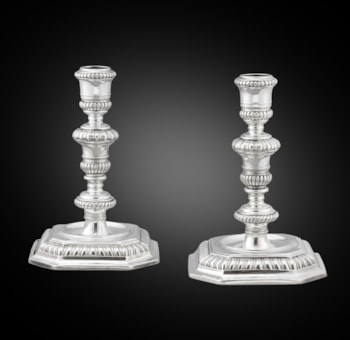
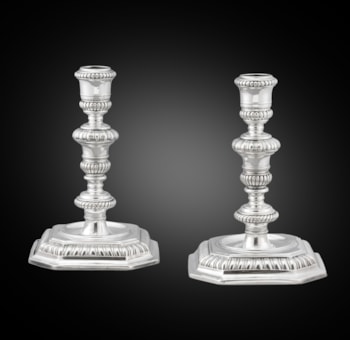
A Pair of Victorian Candlesticks

John Samuel Hunt
A Pair of Victorian Candlesticks

London 1850
By John Samuel Hunt
Stamped to the base Hunt & Roskell Late Storr Mortimer & Hunt, 5047
Height: 28.5cm, 11.2in, Weight: 1,834.9g, 59oz
On plain shaped circular foot, the domed centre engraved with the crest, the spiralling fluted and gadrooned column leading to the socket decorated with an oval shaped border, the shaped circular removable wax pans gadrooned and fluted.
The crest and coronet are that of Richard Charles Francis Christian Meade, 3rd Earl of Clanwilliam GCH (15 August 1795 - 7 October 1879), styled Lord Gillford between 1800 and 1805, was a British diplomat and politician.
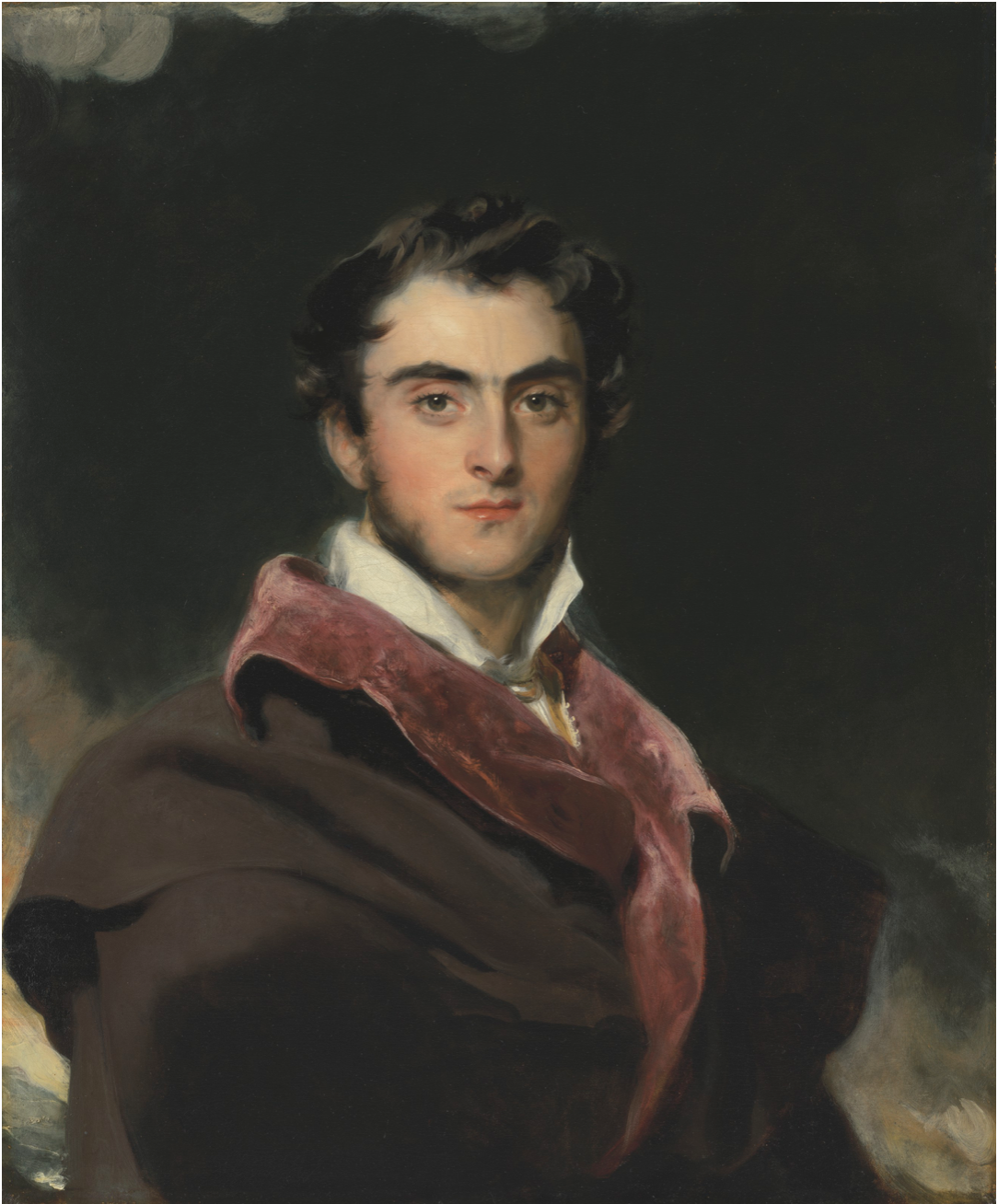
Portrait of Richard Meade, 3rd Earl of Clanwilliam
By Thomas Lawrence
Lord Clanwilliam joined the Diplomatic Service. He attended Lord Castlereagh's suite at the Congress of Vienna in 1814 and was his private secretary from 1817-19 in the latter's capacity as Foreign Secretary. He was one of the first people to see Castlereagh's widow after his suicide: she embraced him warmly, saying that Castlereagh had loved him. It was he who was largely responsible for the decision to give Lord Castlereagh an official funeral in Westminster Abbey, for which he was criticised by those who believed that Castlereagh's own wish was for a private family funeral. He was one of many witnesses who later testified to Castlereagh's increasingly strange mental condition in the days before his suicide.
He became Under-Secretary of State for Foreign Affairs in 1822 and afterwards Envoy to Berlin from 1823 to 1827. In 1828, he was created Baron Clanwilliam, of Clanwilliam in the County of Tipperary, in the Peerage of the United Kingdom.
In 1847 he was awarded the honorary position of Captain of Deal Castle, which he held until his death.
Lord Clanwilliam married Lady Elizabeth Herbert, daughter of George Herbert, 11th Earl of Pembroke, on 5 July 1830. He died in 1879 and was succeeded by his eldest son, Richard. His second son, Sir Robert Henry Meade, later achieved distinction as Permanent Under-Secretary of the Colonial Office.
John Samuel Hunt, nephew of Paul Storr, worked for Storr for many years as a Chaser. In 1826 Hunt became a partner in of the well-known firm of Storr & Mortimer. Following Paul Storr’s retirement in December 1838
Hunt & Roskell was a renowned jewellers and silversmiths on Bond Street in London who for many years held the Royal Warrant of Queen Victoria. The firm was the successor to the celebrated silversmith Paul Storr who had left Rundell, Bridge & Rundell to set up his own workshop on Harrison Street near Clerkenwell in 1819.
A couple of years later he went into partnership with John Mortimer and began trading from 13 New Bond Street as Storr & Mortimer. In 1826 they took an additional partner, John Samuel Hunt, who brought a welcome investment capital of £5,000 with him. The firm was increasingly successful and in 1838 they moved to new premises at 156 New Bond Street settling in just prior to the retirement of Paul Storr at the end of December that same year. This prompted a name change to Mortimer and Hunt which the business operated under from 1839 until 1843 when John Mortimer retired and the name changed one again, this time to Hunt & Roskell. At this time the partners were John Samuel Hunt, his son John Hunt, Robert Roskell Jn. (son of the respected pocket watch maker Robert Roskell from Liverpool) and Charles Frederick Hancock.
The firm now entered a period of growth and prosperity. They were creating wonderful pieces of silverware from tea and coffee pots, salvers and candelabra through to presentation plates and cups as well as ornate and decorative table centre pieces. Their jewellery was equally impressive with diamond tiaras that converted into brooches and hair combs or perhaps a necklace, nestled in display cases next to bracelets set with oval portrait diamonds waiting to be fitted with a client’s choice of miniatures.
They exhibited at the Great Exhibition held in 1851 at the Crystal Palace in London’s Hyde Park where they were noted for the splendour of their display, reputedly worth a total of £100,000. By this time, they had already been granted the Royal Warrant by Queen Victoria, an honour they reflected in their maker’s mark which they surmounted with a crown. Further exhibitions followed both at home and abroad including New York in 1853 and Paris in 1867. The visit to New York was not the first time the company had ventured State side, however. In 1839 they had briefly established a branch in New York under the name Storr & Mortimer, however for reasons unclear it only operated for a couple of years, closing in 1841.
By the 1860’s they were reported to be employing 35 people at the New Bond Street shop and a further 80-100 at the factory on Harrison Street. In addition to their full time employees, they also worked in collaboration with a large number of additional craftspeople as well as retailing both jewellery and silver from other workshops such as that of Carlo Giuliano and Robert Hennell.
The business continued prosperously, and both Robert Roskell’s son Allan and John Hunt’s son John Mortimer Hunt joined their fathers in the firm. After the death of John Hunt in 1879, his son and the two Messrs Roskells continued in partnership until 1888 when Robert Roskell passed away leaving Allan Roskell and John Mortimer Hunt to run the business between them. The following year in 1889 the two men decided to dissolve their partnership and sell the business. It was acquired by J.W. Benson of Ludgate Hill who kept the name and continued trading under Hunt & Roskell until 1897 when it was converted into a limited company and styled Hunt & Roskell Ltd. which is how it remained until trading ceased towards the end of the 1960s.
Hunt & Roskell, a firm of manufacturing and retail jewellers and silversmiths, was founded by Paul Storr in 1819, trading as Storr & Co. (1819-22), Storr & Mortimer (1822-38), Mortimer & Hunt (1838-43) and then Hunt & Roskell (1843-97). Hunt & Roskell had retail premises at 156 New Bond Street and a manufactory at 26 Harrison Street, near Clerkenwell. John Samuel Hunt, who had assisted Storr from the start, continued as a partner until his death in 1865, when he was succeeded by his son, John Hunt (d.1879). Robert Roskell, formerly a watchmaker and merchant of Liverpool, joined in 1844 and remained in the firm until his death in 1888. In 1889 the firm was taken over by J.W. Benson and continued in business as Hunt & Roskell Ltd until c.1965. Trade card in Heal Collection (Heal,67.383) advertises "Hunt & Roskell, Late Storr & Mortimer, Jewellers, Goldsmiths & Silversmiths to The Queen, The Emperor of the French, &c. &c. &c..." Heal's annotations on mount: "Britten's 'Clock & Watchmakers' gives: - Storr & Mortimer, 13, New Bond St. 1830-42. 1826-7 L. Directory gives: - Paul Storr, silversmith, 13, New Bond St. 1827 L. Directory gives: - Storr & Mortimer, gold & silversmiths, 13 New Bond St. 1832 L. Directory gives: - Storr & Mortimer, jewellers, 13 New Bond St. 1838 L. Directory gives: - Storr & Mortimer, silversmiths, 13 New Bond St. 1839 L. Directory gives: - Storr & Mortimer, silversmiths, manufactory, 13 Harrison St. 136 New Bond Street and manufactory, 26 Harrison Street, Gray's Inn Road."
You May Also Like
An Outstanding Paul Storr Soup Tureen
Paul Storr
A Paul Storr Coffee Jug on Stand
Paul Storr
A Pair of George III Candelabra
Francis Butty
A Commonwealth Wine Cup