

















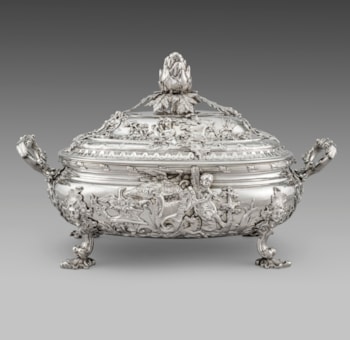



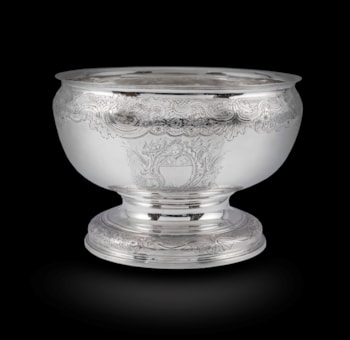




Benjamin Smith II & James Smith III
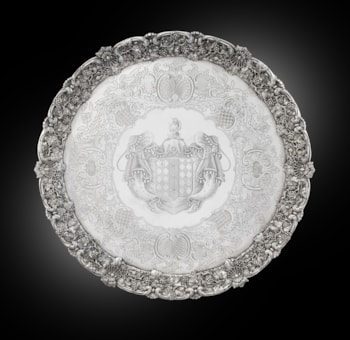
The Robert Troup Tray

Benjamin Smith II & James Smith III
The Robert Troup Tray

A George III Silver-Gilt Two-Handled Tray
London, 1810
Maker’s mark of Benjamin and James Smith
Weight: 5,492 g, 176 oz 10 dwt
Length over handles: 71 cm, 28 in.
The oval two-handled tray stands on four Bacchanalian mask, scroll and goat's hoof feet, with pierced and cast openwork border of scrolls and flower heads, within leaf and tie surround and with foliate handles centring on leopards' masks and fruit. The centre of the tray is engraved with a presentation inscription.
The inscription reads 'THIS SALVER WAS PRESENTED By Sir John Lowther Johnstone of Westerhall Bart TO Robert Troup Esq. in testimony of his Friendship and Esteem' Sir John Lowther Johnstone (c. 1783-1811) was the son of George Johnstone, sometime Governor of Pensacola, West Florida. In 1805 he succeeded his uncle, Sir William Pulteney, as 6th Baronet and inherited the Westerhall estate in Dumfries as well as others in Weymouth and America. At the same time, he claimed the Marquessate of Annandale. For a short while until his death in 1811 he was MP for Weymouth. Robert Troup (1757-1842), the recipient of the tray, was educated at King's College, Cambridge; he emigrated to America and played an important political role in the fledgling United States. In 1778 he became First Secretary of War; in the following year he became Secretary to the Board of the Treasury and subsequently served as a judge in New York. Troup acted as agent to Sir William Pulteney, a role which he presumably continued on Johnstone's behalf after the latter inherited Pulteney's estates.
Obviously related to the grand vine border pattern that was made in quite large numbers for Rundell, Bridge and Rundell, the openwork scrolling foliage border of this tray is very much more unusual. The motifs of the feet and handles are all based on the theme of Bacchus, the god of wine, whose cult was associated with goats and leopards. On some of the related trays the Bacchic references are carried further with a variant handle design that springs from goats' heads.
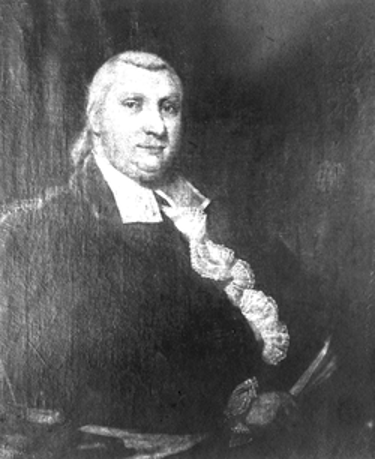
College roommates with Alexander Hamilton and friends with Aaron Burr, Robert Troup (1757-1832) had his finger on the pulse of American politics in the late 18th century. After his service in the Revolutionary War, he practiced law and was nominated by George Washington to the position of Judge of the United States District Court in New York. His relationship with Sir John Lowther Johnstone (1783-1811) formed when Troup worked as the agent for Sir William Pulteney’s estates in western New York from 1801 to 1832, a massive and complicated property that also comprised modern day Ontario. Troup as agent dealt directly with Sir Johnstone as he was a cousin with the Pulteneys and was willed Lady Bath’s, Sir William's daughter, portion of the estate.
Phillips, London, 14 July 1978, lot 137
Victor Niederhoffer
Koopman Rare Art June 1995
Patridge 1996
Koopman Rare Art September 1996
Hartman Rare Art
Koopman Rare Art
Benjamin and James Smith were brother who were in partnership from 1809 until 1812 after having registered their joint mark. They lived and worked in Birmingham, for some time in partnership with Matthew Boulton, before moving to London to work closely with Paul Storr and the renowned firm of Rundell & Bridge. The excellent quality of their work is such that it is comparable to the royal silversmith, Paul Storr; the work of Benjamin Smith can be found in the collection of Her Majesty the Queen.
You May Also Like

The Madame Mère Inkstand
Jean-Baptiste Claude Odiot

The Duke of York’s Tankards
Edward Farrell

1st Earl of Clanbrassil and Viscount Limerick’s Epergne
Eliza(beth) Godfrey

The Anson Plates
Paul de Lamerie