


















Benjamin Smith II & James Smith III
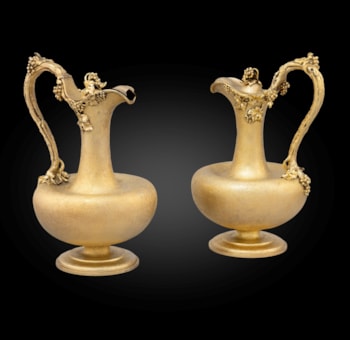
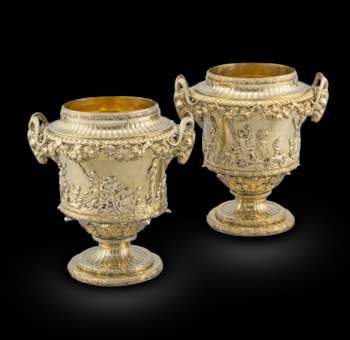
A Pair of George III Silver-Gilt Two-Handled Sugar-Vases

Benjamin Smith II & James Smith III
A Pair of George III Silver-Gilt Two-Handled Sugar-Vases

London, 1810
Maker’s mark of Benjamin Smith & James Smith
Height: 17.2cm, 6.8 in
Weight: 1,586.1g, 51 oz
The vases designed by John Flaxman after the Antique, on spreading circular base with bracket feet, the base cast with stylised leaves on matted ground and the partly fluted body cast with scrolling acanthus foliage, with snake handles, the domed cover cast with vines and with bud finial
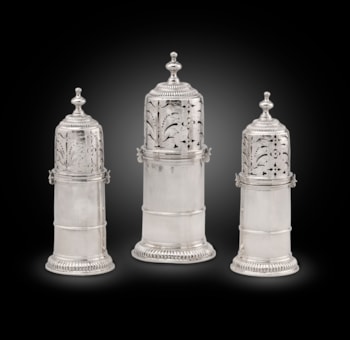
The vases also have two fiddle thread and shell pattern sugar-sifters, 1816 and 1839.
The design for these vases is derived from an antique vase formerly in the collection of the Marquess of Lansdowne (Christie's, 5 March 1930, lot 111) (1) The model was clearly familiar to John Flaxman junior who used it with slight variations as early as 1796 to surmount the monument to Sir Thomas Burrell in West Grinstead Church, Sussex (2) A drawing of a very similar vase is amongst the Flaxman material at the Victoria & Albert Museum (8969A). Flaxman was persuaded to design for the Royal Goldsmiths, Rundell, Bridge and Rundell in or before 1805, a relationship that probably lasted until his death in 1826. The model was first used in silver-gilt by Benjamin Smith, in partnership with Digby Scott, in 1805 at which time Smith was running Rundell’s workshop at Lime Kiln Lane, Greenwich. The model was subsequently used by Paul Storr following the closure of the Greenwich workshop in 1813-1814. Eight examples by Smith are in the Royal Collection. (3)
1. David Udy, 'Piranesi's Vasi, Burlingion Magazine (December 1978), p. 837, fig. 55
2.Edward Croft-Murray, 'An account of John Flaxman' Walpole Society, XXVIII, (1938), pl. XVIII
3. Shirley Bury, 'The Lengthening Shadow of Rundells' Connoisseur (1966), p. 81
Benjamin and James Smith were brother who were in partnership from 1809 until 1812 after having registered their joint mark. They lived and worked in Birmingham, for some time in partnership with Matthew Boulton, before moving to London to work closely with Paul Storr and the renowned firm of Rundell & Bridge. The excellent quality of their work is such that it is comparable to the royal silversmith, Paul Storr; the work of Benjamin Smith can be found in the collection of Her Majesty the Queen.
You May Also Like

An 18th Century Jewelled Two-Coloured Gold and Enamel Snuff Box

A George III 18 Carat Gold Snuff Box
Alexander Strachan

A Pair of Victorian Chinoiserie Tea Caddies in a Georgian Silver-Mounted Case
Charles Thomas & George Fox

An early 20th century diamond bracelet