























Paul de Lamerie
( 1688 - 1751 )
The Mitchell Salver

Paul de Lamerie
( 1688 - 1751 )
The Mitchell Salver

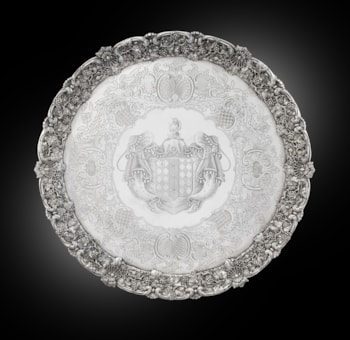
A Superb George II Salver
London, 1739
Maker’s mark of Paul De Lamerie
The arms are those of Mitchell, probably for Andrew Mitchell (1708-1771), of Edinburgh.
Weight: 645 g, 20oz 10 dwt
Diameter: 24.5 cm, 9.63 in
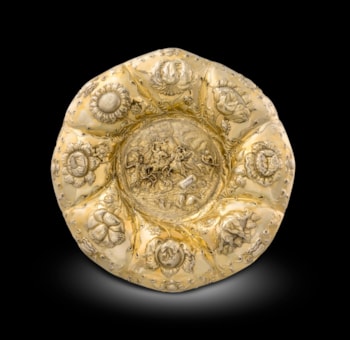
The salver shaped-circular, on three scrolling feet, engraved with the coat-of-arms and chased with rococo motives and shells.
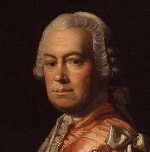
Sir Andre Mitchell (1708–1771), diplomatist, born at Edinburgh on 15 April 1708, was the only surviving son of William Mitchell, of an Aberdeenshire family, minister of St. Giles's, Edinburgh, and one of the king's chaplains for Scotland. Mitchell received part of his education at the university of Edinburgh. Before he was twenty-one he married his cousin, Barbara Mitchell, an only daughter, and heiress of the lands of Thurnston in Aberdeenshire. She died about 1729, having given birth to an only daughter, who did not survive infancy. At the time Mitchell was studying for the Scottish bar, but the event affected him so deeply that he never afterwards resided in Scotland for any length of time. After several years spent in foreign travel, he was entered at Leyden University 5
Oct. 1730, and having formed at Paris an intimacy with Montesquieu, he settled in London in 1735 and studied for the English bar. He was elected a member of the Royal Society in March 1735, and was called to the bar at the Middle Temple on 12 May 1738. In 1741 he was served, in right of his wife, heir to the Thurnston estates. In the following year the Marquis of Tweeddale [see Hay, John, fourth Marquis], on becoming secretary of state for Scotland, appointed him under-secretary. Quin the actor, in conversation with Mitchell, hinted that his official employment was simply that of Will helping Jack to do nothing (Walpole, v. 235), but with the breaking out of the rebellion of 1745 Mitchell's office became no sinecure. His functions ceased in 1747 with the abolition of the Scottish secretaryship of state. But he was afterwards consulted by the government respecting the affairs of Scotland, and the Duke of Newcastle aided him in what proved to be his successful candidature for Aberdeenshire. He was elected as a staunch whig in 1747. He was an intimate friend of James Thomson, the poet of the ‘Seasons,’ who, dying in 1748, left Mitchell one of his executors. He spoke occasionally in the House of Commons, and in 1751-2 he was at Brussels as one of the British commissioners appointed to negotiate a commercial treaty with Austria and the Netherlands. From 1755 to 1761 he was M.P. for the Elgin burghs, but during most of the period he was absent from England, having been appointed in 1756 British envoy to Frederick the Great.
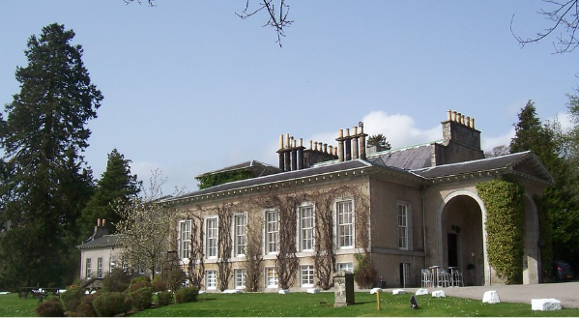 Thainstone House, Inverurie
Mitchell reached Berlin just before the breaking out of the seven years' war and the formation of an Anglo-Prussian alliance. Frederick and he became strongly attracted to each other. Mitchell was admitted to confidential intercourse with the king, whose appeals for a strict fulfilment of the engagements which England had entered into with Prussia were warmly supported by Mitchell in his correspondence with his government. Frederick willingly acceded to Mitchell's application, made in pursuance of instructions from home, to be allowed to accompany him in his campaigns, and he was often by the king's side in the battlefield and under fire. The clear and instructive narratives of military operations sent home by Mitchell interested George II, and their value has been recognised by Carlyle. Mitchell's reports of Frederick's frank and lively conversations with him abound in striking traits and anecdotes of the great king. Some remarks in one of his despatches appear to have given offence to the elder Pitt, and he was recalled, General Yorke being sent to supersede him. But Frederick insisted that Mitchell should remain, and without quitting Berlin he resumed his functions as envoy. This was in 1758, and in 1759 he was raised to the rank of plenipotentiary. While attached to Frederick and approving of his policy, Mitchell did not hesitate to speak his mind freely to him in regard both to politics and to religion. They had more than once discussions on the providential government of the world, in which Frederick did not believe, while Mitchell advocated the orthodox view. In the intervals of campaigning Mitchell learnt German, one of his earliest teachers being Gottsched, whose attack on Shakespeare for neglecting the unities he repelled with considerable wit (Carlyle, vii. 317). Mitchell's acquaintance with the rising German literature of the time was much greater than that of Frederick, on whom he urged its claims to royal recognition (ib. ix. 154).
Lord Bute, on becoming prime minister in 1762, aimed at bringing the seven years' war to an end, and discontinued the subsidies to Frederick, who wrote in that year to one of his correspondents: ‘Messieurs the English continue to betray. Poor M. Mitchell has had a stroke of apoplexy on hearing of it.’ There was now a diminution of the king's confidential intercourse with Mitchell, who had become the envoy of a government unfriendly to Frederick. In 1764, peace having been restored to Europe, Mitchell revisited England. He had been re-elected for the Elgin burghs in 1761, and continued to represent them, at least nominally, until his death. In 1765 he was invested, but not installed, a knight of the Bath (Foster, p. 252). In the following year he returned as envoy to Berlin. But as Frederick rejected Chatham's proposal of a triple alliance between England, Prussia, and Russia, which Mitchell was instructed to urge on him, the old intimacy of the king and Mitchell remained in abeyance. Mitchell's later despatches contain severe animadversions on Frederick's debasement of the coinage and general fiscal policy.
Mitchell died at Berlin on 28 Jan. 1771, and Frederick is said to have shed tears as he witnessed from a balcony the funeral procession. He was buried in a Berlin church, in which a year or so afterwards a bust of him was placed at the instance of Prince Henry, Frederick's brother. Mitchell is described as strongly built, and rather above the middle height. His portrait at Thurnston is that of a bold, straightforward, and most sagacious man. He is said to have been taking in his manner, but rather blunt. Carlyle speaks of him as ‘an Aberdeen Scotchman creditable to his country; hard-headed, sagacious, sceptical of shows, but capable of recognising substances withal and of standing loyal to them, stubbornly if needful … whose Letters are among the perennially valuable Documents on Friedrich's History.’ The anecdotes of Mitchell, given by Thiébault, some of which are often quoted, are not to be relied on when Thiébault is repeating the gossip of others. Mitchell himself, however, told him, he asserts, that when Frederick was least satisfied with England, Mitchell was reproached by the government at home with not reporting Frederick's bitter sarcasms on their policy, and that in reply he declared his determination to resign rather than play the part of tale-bearer.
Christie's, London, 23 June 1976, lot 104
A kettle engraved with these coat-of- arms, also marked for de Lamerie, London, 1739, was sold Christie's, New York, 16 April 1999, lot 204.
Paul de Lamerie arrived in England with his Huguenot parents in or before 1689, having been baptized at 's Hertogenbosch in the Netherlands in 1688. In 1703 he was apprenticed to the Huguenot goldsmith Pierre Platel, and after being admitted to the freedom of the Goldsmiths' Company, he registered his first mark and set up a workshop in Windmill Street, Soho, in 1712. He took thirteen apprentices between 1715 and 1749 who paid premiums varying between £10 and £45m In 1716 he married Louisa Juliott, also a Huguenot, and by her had six children, three of whom died in childhood. Little more of his personal history is known, although his career in the Goldsmiths' Company is comparatively well documented. By 1717, he was already referred to as 'the King's Silversmith' but again in a complaint 'for making and selling Great quantities of Large Plate which he doth not bring to Goldsmith's Hall to be mark't according to Law.' He joined the livery in 1717; fourteen years later he was elected to the court of assistants. In 1743 he was appointed fourth warden and in 1747 second warden; that he never became prime warden probably due to ill health. From the outset he had wealthy clients such as the Honourable George Treby and the Duke of Sutherland. Among his more important later patrons were Sir Robert Walpole, Baron Anson, and the fifth Earl of Mountrath. A gradual expansion of his business culminated in his move in 1739 to considerably larger premises in Gerrard street. His pre-eminent position in the trade is signified by the commission he received in 1740 from the Goldsmiths' Company to provide two of their most splendid pieces of ceremonial display plate, a silver-gilt inkstand and the famous rococo ewer and dish.
You May Also Like
A Rectangular Paul Storr Tray
Paul Storr

A Pair of Regency Wine Coolers
Paul Storr

A Victorian Fourteen Basket Epergne
Francis Boone Thomas
Victorian Oval Two-handled Verriere
James Garrard