























Paul Storr
( 1771 - 1844 )
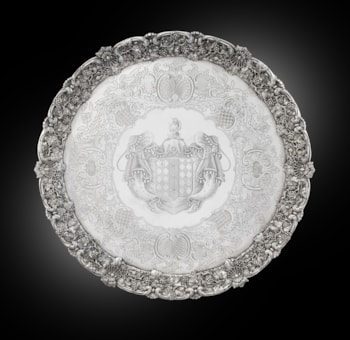
The Earl of Airlie’s Tray

Paul Storr
( 1771 - 1844 )
The Earl of Airlie’s Tray

A George III Silver Tray
London, 1814
Maker’s mark of Paul Storr
Length: 81.7cm, 32.1 in
Weight: 7,703g, 247ozs.
The scale of this tray is truly exceptional. The tray of shaped oval form and resting on four waterleaf and rosette feet, with gadrooned shell, foliate scroll and anthemion border, with two reeded bracket handles with acanthus foliage terminals. The centre engraved with a coat-of-arms with earl's coronet above. The tray fully hallmarked to its reverse.
Walter Ogilvy, 8th Earl of Airlie
Walter Ogilvy, Earl of Airlie was born in 1733.1 He was the son of John Ogilvy, Earl of Airlie and Margaret Ogilvy.1,2 He married, firstly, Margaret Fullerton, daughter of William Fullerton, Lord Spynie, before 31 May 1748.3 He married, secondly, Jean Ogilvy, daughter of John Ogilvy and Margaret Ogilvy, on 12 November 1780 at Forfar, Angus, ScotlandG.1 He and Jean Ogilvy were divorced in 1798.4 He died on 10 April 1819 at Cortachy, Angus, Scotland.1
He was styled as Earl of Airlie.1 He was admitted to the Faculty of Advocates on 19 February 1757 at Edinburgh, Midlothian, ScotlandG.1 He succeeded as the 7th Lord Ogilvy of Alith and Lintrathen, co. Forfar [S., 1639] on 3 March 1803, de jure.5 He succeeded as the 7th Earl of Airlie [S., 1639] on 3 March 1803, de jure.5 Generally regarded as the Earl of Airlie, he claimed the honours were unaffected by the forfeitures of his brother and uncle, but the English Judges, when consulted by the House of Lords, were of the opinion that these attainders operated against him.1
Children of Walter Ogilvy, Earl of Airlie and Jean Ogilvy
- Margaret Ogilvy+6 d. 12 Dec 1870
- Charles Ogilvy7 d. 28 Mar 1791
- Susan Ogilvy8 d. 2 May 1787
- Anne Ogilvy8 d. 1848
- Mary Ogilvy8 d. 1 Oct 1868
- Captain John Ogilvy9 b. b 1785, d. 1809
- David Ogilvy, 8th Earl of Airlie+1 b. 16 Dec 1785, d. 20 Aug 1849
- Jean Ogilvy8 b. c 1787, d. 25 Nov 1807
- Donald Ogilvy+9 b. 10 May 1788, d. 30 Dec 1863
- William Ogilvy7 b. bt 1789 - 1810, d. 10 Apr 1871
- Helen Ogilvy+8 b. 12 Feb 1798, d. 27 Apr 1868
The Earls of Airlie are a Scottish noble family with a rich history dating back to the 15th century. The title was created in 1639 for James Ogilvy, 7th Lord Ogilvy of Airlie, and the family has held lands in Angus since at least that time. Their historical seat is Airlie Castle, which dates back to 1432, and Cortachy Castle, acquired in 1625. The family is known for their support of the Scottish and later British monarchy, with notable members including Robert the Bruce and the Stuarts.
Citations
[S6] G.E. Cokayne; with Vicary Gibbs, H.A. Doubleday, Geoffrey H. White, Duncan Warrand and Lord Howard de Walden, editors, The Complete Peerage of England, Scotland, Ireland, Great Britain and the United Kingdom, Extant, Extinct or Dormant, new ed., 13 volumes in 14 (1910-1959; reprint in 6 volumes, Gloucester, U.K.: Alan Sutton Publishing, 2000), volume I, page 74. Hereinafter cited as The Complete Peerage.
[S8] BP1999 volume 1, page 45, says he is son of David Ogilvy, not son of John Ogilvy. See link for full details for this source. Hereinafter cited as. [S8]
[S2] Peter W. Hammond, editor, The Complete Peerage or a History of the House of Lords and All its Members From the Earliest Times, Volume XIV: Addenda & Corrigenda (Stroud, Gloucestershire, U.K.: Sutton Publishing, 1998), page 14. Hereinafter cited as The Complete Peerage, Volume XIV.
[S323] Sir James Balfour Paul, The Scots Peerage: founded on Wood's edition of Sir Robert Douglas's The Peerage of Scotland (Edinburgh, Scotland: David Douglas, 1904), volume IX, page 8. Hereinafter cited as The Scots Peerage.
[S37] BP2003 volume 3, page 4553. See link for full details for this source. Hereinafter cited as. [S37]
[S6] Cokayne, and others, The Complete Peerage, volume I, page 185.
[S323] Sir James Balfour Paul, The Scots Peerage, volume I, page 129.
[S323] Sir James Balfour Paul, The Scots Peerage, volume I, page 130.
[S8] BP199 [S8]
E & C.T Koopman & Son
The Collection of Al Tajir.
Christie's, London, Magnificent Silver and Silver-Gilt, 17 March 1999.
Son of Thomas Storr of Westminster, first silver-chaser later innkeeper, born 1771. Apprenticed c'1785. Before his first partnership with William Frisbee in 1792 he worked at Church Street, Soho, which was the address of Andrew Fogelberg. This is also the address at which Storr's first separate mark is also entered. First mark entered as plateworker, in partnership with William Frisbee, 2 May 1792. Address: 5 Cock Lane, Snow Hill. Second mark alone, 12 January 1793. Address: 30 Church Street, Soho. Third mark, 27 April 1793. Fourth 8 August 1794. Moved to 20 Air Street, 8 October 1796, (where Thomas Pitts had worked till 1793). Fifth mark, 29 November 1799. Sixth, 21 August 1807. Address 53 Dean Street, Soho. Seventh, 10 February 1808. Ninth, 21 October 1813. Tenth, 12 September 1817. Moved to Harrison Street, Gray's Inn Road, 4 March 1819, after severing his connection with Rundell, Bridge and Rundell. Eleventh mark, 2 September 1883. Address: 17 Harrison Street. Twelfth and last mark, 2 September 1833. Heal records him in partnership with Frisbee and alone at Cock Lane in 1792, and at the other addresses and dates above, except Harrison Street. Storr married in 1801, Elizabeth Susanna Beyer of the Saxon family of piano and organ builders of Compton Street, by whom he had ten children. He retired in 1838, to live in Hill House in Tooting. He died 18 March 1844 and is buried in Tooting Churchyard. His will, proved 3 April 1844, shows an estate of £3000. A memorial to him in Otely Church, Suffolk was put up by his son Francis the then incumbent of the parish. For full details of Storr's relationship with Rundell, Bridge and Rundell please see N.M. Penzer, 1954 or Royal Goldsmiths, The Art of Rundell and Bridge, 2005.
Storr's reputation rests on his mastery of the grandoise neo-Classical style developed in the Regency period. His early pieces up to about 1800 show restrained taste, although by 1797 he had produced the remarkable gold font for the Duke of Portland. Here, however the modelling of the classical figures must presumably have been the work of a professional sculptor, as yet unidentified, and many of the pieces produced by him for Rundell and Bridge in the Royal Collection must have sprung from designs commissioned by that firm rather than from his own invention. On the other hand, they still existed in his Harrison Street workshop, until destroyed in World War II, a group of Piranesi engravings of classical vases and monuments bearing his signature, presumably used as source material for designs. The massiveness of the best of his compositions is well shown in the fine urn of 1800 at Woborn Abbey, but the Theocritus Cup in the Royal Collection must be essentially ascribed to the restraint of its designer John Flaxman, while not denying to Storr its superb execution. Lord Spencer's ice pails of 1817 show similar quality. Not all Storr's work however was of classical inspiration. The candelabra of 1807 at Woburn derive from candlesticks by Paul Crespin of the George II period, formerly part of the Bedford Collection, and he attempted essays in floral rococo design from time to time, which tend to over-floridity. On occasions the excellence of his technical qualities was marred by a lack of good proportions, as in the chalices of the church plate of St Pancras, 1821. In spite of these small lapses there is no doubt that Storr rose to the demands made upon him as the author of more fine display plate than any other English goldsmith, including Paul De Lamerie, was ever called upon to produce.
You May Also Like

A George I Silver-Gilt Two-Handled Cup with Cover
Anthony Nelme

An art deco emerald and diamond double clip

An early 20th century natural seed pearl and diamond necklace

An early 20th century diamond and pearl fringe brooch