
























Edward Farrell
( 1850 )
The Duke of York’s Tankards

Edward Farrell
( 1850 )
The Duke of York’s Tankards

A Pair of Monumental George IV Historismus Tankards
London, 1821
Maker’s mark of Edward Farrell
Most probably retailed by Kensington Lewis
Height: 48 cm, 18.9 in
Weight: 8,780g, 282 oz 6 dwt
This pair of tankards if an outstanding example of the daring, eclectic historicism that was a specialty of the London silversmith Edward Farrell who collaborated with Kensington Lewis, a retailer. Farrell's work is characterized by boldly chased and cast decoration inspired by Renaissance, Baroque and Rococo designs. Lewis supplied silver to many patrons in the circle of the Prince Regent, but it was famously Prince Frederick Augustus, Duke of York who was his most voracious client.
Here we see an incredible almost three-dimensional Roman battle scene with Emperor Constantine at its centre. The array of chased figures, armour, cavalry and detailed expressions of the men at war is extraordinary. This intertwined with the field of battle with its grass row of flowers and tree trunks with their branches towering above the soldiers is a masterclass in the art of embossing, chasing and loss wax casting, with the elements applied in layer upon layer, is simply breathtaking.
The hands formed as three intertwined satyrs grasped by a winged grotesque dolphin. The covers with a further battle scene and a magnificent cavalry soldier grasping a baton. The baton on the battlefield serves as a symbol of authority and command for high-ranking military officers. Historically, it has evolved from ancient weapons to a ceremonial staff, representing the transfer of power and leadership.
The skirts to these tankards, that the main barrels rests upon are decorated with Bacchic satyrs, holding amphoras in their arms in a celebration of the fruits of the earth, further accentuated by the incredible chased array of fruit, foliage and vegetables of every kind. This is very in harmony and keeping with the Duke of York’s famous Vegetable service.
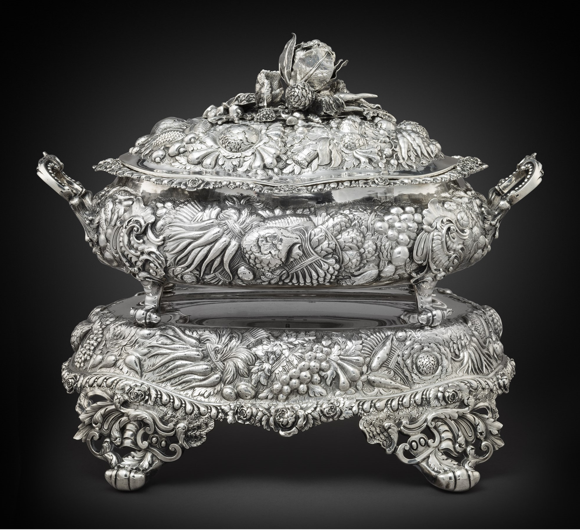
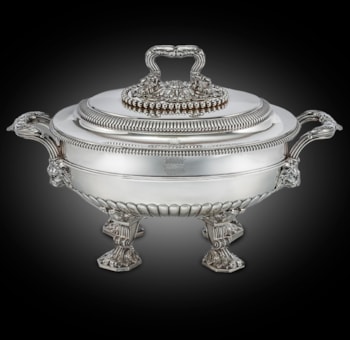
The Duke of York’s Soup Tureen on Stand from the ‘Vegetable Service’
An Important Soup Tureen on Stand
London, 1823 Maker’s mark of Edward Farrell
Formerly in the Koopman Rare Art Collection
The soup tureen and stand of oval form, the sides and detachable cover chased with vegetables and flowers within foliage scrolls, with two cast shell capped handles, the cover with a fabulous cast vegetable finial comprising of turnips, artichoke, cauliflower, mushrooms and leeks. The cast border of the soup tureen adorned with white roses for the House of York.
Part of the massive 'Vegetable Service' supplied to Fredrick, Duke of York (1763-1827) by Kensington Lewis. This soup tureen belonged to the extensive dinner-service decorated with vegetables made in 1823 for the Duke of York by Edward Farrell under the direction of Kensington Lewis, silver retailer and chief promoter of the most innovative styles of the period. Christie's 1827 auction catalogue of the Duke of York's silver describes the service in 35 lots under the heading "SERVICE OF SUMPTUOUS PLATE . . . of rich and massive manufacture (made by Lewis,) the surface covered with vegetables in high relief, very boldly executed, and producing a very rich effect."
The Duke of York, as Commander-in-Chief of the forces of Great Britian and Ireland, was accused of corruption in 1809, chiefly on account of the practices of his mistress Mary Anne Clark in obtaining promotions for Army officers. He was acquitted by a vote of the House of Commons but compelled to resign his post for two years. "It is foible of history that the Duke is now chiefly remembered in the public mind as the man who marched his army up and down a hill and ran it, as a commercial proposition, with the aid of his mistress" (Complete Peerage).
As a gourmand and connoisseur of wine, the Duke was well known. He employed Louis XVI's former chef, Louis Eustach Ude, who stayed with him until the Duke's death.
Following the example of his brother, the Prince Regent, the Duke amassed a considerable collection of silver, much of it supplied by Kensington Lewis, who generally employed Edward Farrell as maker.
The greatest commission undertaken by Farrell for Lewis and the Duke was the celebrated candelabrum weighing some 1144 ounces formed as Hercules Slaying the Hydra, subsequently sold by Christie's, London, October 18, 1967, lot 59 (illustrated in A. Phillips et al., Antiquity Revisited: English and French Silver-Gilt in the Collection of Audrey Love, 1997, cover and fig.12, pp. 62-67).
On the Duke's death of dropsy in 1827, it was discovered that he had debts totalling between 200,000 gbp and 500,000 gbp. It is indicative of the confused state of his financial affairs that his executors were unable to provide a more specific figure. On account of this, they took the unprecedented step of placing his collections up for public auction, entrusting the young James Christie II with the sale, which took place March 19-22, 1827.
The sale, which totalled 22,438 gbp was not a success; Lewis was forced to buy back much of what he had sold the Duke at vastly inflated prices only a few years before. Many of the items, such as the Hercules candelabrum, failed to reach half of their original cost, prompting Christie to observe that "the sacrifice was indeed great."
It is very likely that these 1821 tankards were originally in the possession of Prince Frederick Augustus, Duke of York (1763-1827), sold at Christie’s, London, on 20 March 1827, lots 98 and 99.
Kensington Lewis & Edward Farrell
The antiquarian and silver retailer Kensington Lewis, whose trade card proudly describes him as ‘Silversmith and Jeweller to his R. H. the Duke of York', had (amongst others) Edward Farrell working for them.
Edward Farrell worked in association with Kensington Lewis between about 1816 until the mid-1830s. The Duke of York was Lewis’ most important patron and his business suffered after the Duke’s death.
The name Kensington Lewis, is associated with some of the most innovative silver of the early 19th century. This is particularly true with the extraordinary group of silver which he supplied to Prince Fredrick Augustus, Duke of York the second son of King George III. His work anticipates the full-blown historicism of the mid-19th century. The Duke of York and his elder brother, the Prince Regent, later King George IV, were together the most influential collectors and patrons of silver of their time. The Duke of York's silver, however, was based largely on baroque sources, and stands apart from the classical styles promoted by the Royal Goldsmiths, Rundell Bridge & Rundell and supplied to the King.
Credit for the distinctive style of the Duke of York's silver must be given to Kensington Lewis, whose passion for 17th-century silver was demonstrated by his purchases in the Duke of Norfolk's auction in 1816. There, he acquired a salver decorated with "figures of marine deities" or "sea nymphs and tritons in relief," and a tankard with "a feast of the Gods, in exquisite bas-relief ... Alexander visiting the tent of Darius ... the handle formed as a syren." Such objects in Lewis's possession undoubtedly influenced his designs for new silver objects, executed for him by Edward Farrell. John Culme proposed this thesis in his important study, "Kensington Lewis: A Nineteenth Century Businessman," Connoisseur, September 1975.
Lewis, an expert salesman, was able to channel the Duke of York's profligate spending toward Farrell, a talented silversmith capable of creating new designs from a variety of historical sources. It was this phenomenal collaboration of patron, retailer, and craftsman which resulted in these extravagant and highly original objects.
Farrell's apprenticeship or freedom are unrecorded, and his early life is relatively unknown. Holden's Triennial Directory of 1805-7 described him as a silversmith, but his first mark was not registered until 1813. The most productive period of Farrell's career coincided with his association with the entrepreneur, silversmith, and jeweller Kensington Lewis, whose most important patron was Frederick, Duke of York. Lewis was supplied with extravagant sculptural plate in a variety of revival styles by Farrell, drawing principally on seventeenth-century Flemish, German and Italian designs in high relief. Lewis' business was unable to recover from the death of the Duke of York in 1827, and Farrell no longer had the opportunity to make the plate on such a grand scale. Thereafter, he was best known for highly embossed tea services chased with decoration derived from seventeenth-century Dutch genre painting.
You May Also Like

Baron Feversham’s Wine Coasters
John Bridge

The Waller Tureen
George Heming & William Chawner

Charles Anderson Pelham, 1st Baron Yarborough’s Tea & Coffee Service
Paul Storr

An Important George II Soup Tureen
George Wickes