























A George III Race Trophy

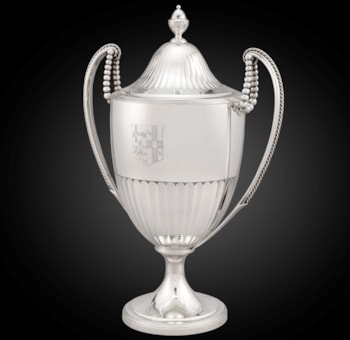
A George III Race Trophy

London, 1782
Maker’s mark of Henry Green
Height: 61 cm, 24 in
Weight: 4,548 g, 1246 oz 4 dwt
The cup of tapering cylindrical form resting on a circular half-fluted pedestal foot decorated with laurel leaves and berries, and Vitruvian scrolls. The main body with a band of trailing acanthus and quatrefoils, half fluted with acanthus leaves the applied swags of laurel framing the two applied plaques depicting race horses and jockeys at race on the flats. The plaques very much in the style of George Stubbs. The top of the main body with a band of Vituvian scrolls bordered by beaded wires. The cover mirroring the base of the cup and surmounted by the cast figure of Victory.
Engraved:
The Sandringham Gold Cup , Lansdsown Park June 27 1895
2 yrs old, 5 furlongs
Won by Mr Leopold de Rothchild’s
“St Frusquin”
J J Calder 9 st
Sandown Park Racecourse opened in 1875 and was the first in the country to charge for attendance – it was half a crown to enter!
It was also the first to have an exclusive member’s enclosure (the Premier enclosure): now considered a standard facility everywhere.
Sandown Park is situated in a natural amphitheatre, which made it easy to construct as a purpose-built facility with strict attendance. The stand sits on the top of a hill, allowing the runners, even when down the back straight, to be easily picked out.
The first-ever race meeting at Sandown Park spanned three days and featured the Grand National Hunt Chase, which is now held annually as part of the Cheltenham Festival. The Grand International Steeplechase took place during the same event with an impressive prize fund of £2,130 – more than even the winner of the infamous Grand National took home that year!
Once considered the norm, today Sandown Park is one of a few racecourses that still offer both national hunt and flat racing as part of its horse racing season. It has hosted some of the best racehorses from both codes competing on its turf.
Henry Green
Charles Aldridge, apprenticed to his uncle Edward Aldridge 1758, free 1766. First mark as plateworker, in partnership with Henry Green, 1775. Second mark alone 1786. Third small mark 1789.
Henry Green, free of the Girdlers Company 1772. Mark entered as plateworker, in partnership with Charles Aldridge, 1775. Second mark alone, 3 sizes, 1786.
Henry Green was a notable silversmith in London, known for his partnership with Charles Aldridge. His work as a plateworker began in 1775, and he continued to produce high-quality silverware until his death in 1876. Green's work is characterized by its traditional design and craftsmanship, with a focus on quality.
Leopold de Rothschild, presented as the Sandringham Gold Cup in 1895 and probably by descent to his son
Anthony de Rothschild.
Possibly Anthony de Rothschild, Esq.; Christie's London, 23 October 1940.
with Partridge, New Bond Street, London, 24 January 1977 and by descent to the present owner.
You May Also Like

An Extremely Rare Pair of William & Mary Candlesticks

A Pair of incredibly Rare 16th Century Silver-gilt Mounted Carved Amber Pricket Candlesticks

An Important Set of Four George II Table Candlesticks
Paul de Lamerie

A George III gold mounted and carved mocha agate snuff box