
























Parker & Wakelin
The Earl of Buckingham’s Wine Coolers

Parker & Wakelin
The Earl of Buckingham’s Wine Coolers

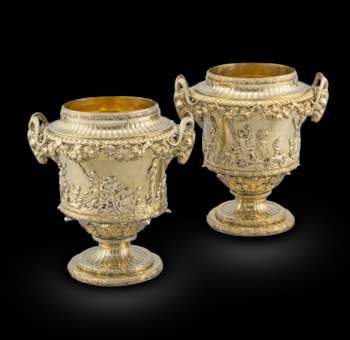
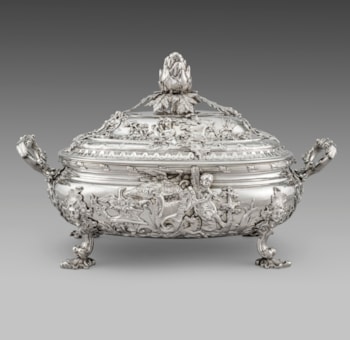
A pair of royal George III silver wine coolers
London, 1763
Maker’s mark of John Parker & Edward Wakelin
Height: 26 cm, 10¼in. high, Weight: 6875gr., 221oz
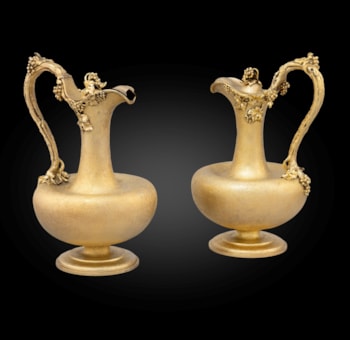
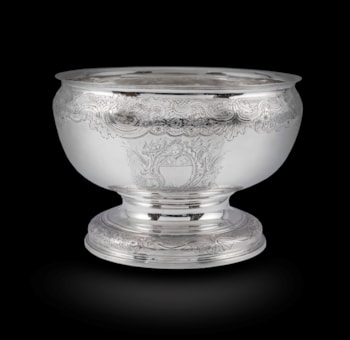
These magnificent Royal wine coolers made in inverted baluster form. Their bases are applied with grapes and olive branches and their bodies partly fluted. Of course, applied with George III’s royal arms on both sides, with floral swags leading to the grape vine handles, the gadrooned rims centred with shells. Each wine cooler also with inventory numbers and scratch weights engraved "N°1, 110=4” and “N°2, 113=7.
As early as the 16th century, silver in Britain was not only a measure of wealth but also a tool of diplomacy and cultural display. The ambassadorial services were a strategic and symbolic tool in British diplomacy, combining artistry, wealth, and ceremonial function that reinforced the prestige of the Crown and its emissaries abroad.
Our ambassadors were expected to entertain in a manner that reflected the dignity and power of the English crown. To achieve this, the Jewel Office, a division of the royal household responsible for precious metals, issued silver services to officials posted at foreign courts. These services included elaborate dinnerware such as tureens, sauceboats, serving dishes, and cutlery, often designed to accommodate large gatherings of thirty-six guests or more.
Serving far more than just their obvious function, the Ambassadorial services were expressions of taste, education, and sophistication. The silversmiths produced highly detailed and technically sophisticated pieces. Their work featured die-stamped borders, intricate engraving, and animated grotesques, reflecting both artistic skill and the prestige of the Crown. The silver was sometimes displayed on buffets to impress foreign dignitaries, with royal arms prominently engraved or cast to signify the ambassador’s official status.
When sending an ambassador abroad. They would receive diplomatic pay and expenses, and the material objects with which they were furnished in their role as the king’s representative. These comprised large quantities of silver plate from the Jewel House and a chair of state and canopy from the Great Wardrobe; diplomats were also provided with allowances for commissioning the monarch’s portrait and gala coaches for their formal entry. During the fifty years after 1660 a notable evolution occurred in which diplomats played a greater personal role in the fashioning of their royal perquisites, and during which the dictates of elite fashion affected the way they looked and the goldsmiths, joiners, and craftsmen who were employed. By 1714 an ambassador’s official environment had become as much a reflection of his own tastes as those of diplomatic precedence.
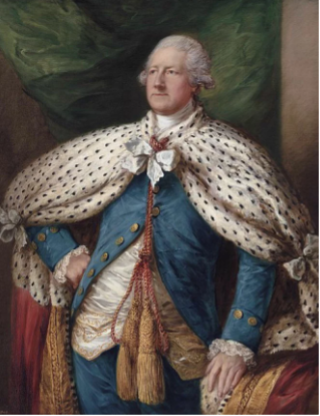
Portrait of John, 2nd Earl of Buckinghamshire by Thomas Gainsborough, oil on canvas
John Hobart, 2nd Earl of Buckinghamshire (1723-1793) was chosen as Ambassador to Russia and the court of Catherine the Great between 1762 and 1765 partly for his strikingly handsome appearance, which was ‘likely to ingratiate him with the Empress Catherine.’1 She was duly impressed and during much of his time in Russia, the Empress was said to have ‘showered favours’ on Buckinghamshire, who wrote in his diary, 'to see her is to know that she could love and that her love would make the happiness of a lover worthy of her.’2
He was born in 1723 to John Hobart (1693-1756), from 1728 Baron Hobart of Blickling, and from 1746 1st Earl of Buckinghamshire. Despite considerable political experience, he was thought to owe his peerage to his sister Henrietta, Countess of Suffolk, Mistress to George II. The son served as M.P. for Norwich from 1747 to 1756, as Comptroller of the Household in 1755-56, Privy Councillor in 1756, Lord of the Bedchamber to George II from 1756 to 1760 and to George III from 1760 to 1767. Horace Walpole wrote a typically waspish description of him as ‘The Clearcake – fat, fair, sweet, and seen through in a moment.’3 He married in 1761 Mary Anne, daughter and co-heir of Lieutenant General Sir Thomas Drury, Bt., who brought him a fortune of £50,000.
The Embassy
The Earl was sent to Russia as part of the diplomatic manoeuvring at the close of the Seven Years' War. His dispatches reveal how busy he was: keeping England informed of the shifting balances of power at the new Court, pushing for an Anglo-Russian alliance and trade treaties, feeling out the possibilities of a Northern Confederacy, and debating the fate of Poland after the death in 1763 of Augustus III. They also indicate how much entertaining was part of his duties. During one of the periods of unrest, he had all of the foreign ministers dining with him to discuss the situation, while at other times he hosted Catherine's Chancellor and her private secretary; of the latter, soon to be Secretary of State, he wrote, ‘the table is his first passion.’4 In April 1763, the Earl wrote to Lord Halifax: ‘The Empress had flattered me with the hope that she would honour my house with her presence on Monday last, as she had done before at an entertainment of the same kind.’5
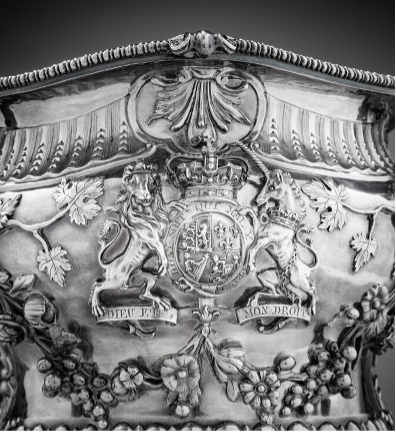
In August 1762, in preparation for his duties, Lord Buckinghamshire received an extensive allotment of plate from the Jewel House; he had hoped to arrive in time for Catherine's Coronation on 22 September but, in the event, his plans were thwarted. This first selection of silver included an epergne, dinner plates, sauce boats and salts to dazzle guests at his new posting.6 As the letters show, though, he was soon being blessed with visits from the Empress herself. The following year he ordered additional pieces, not listed in the Jewel House records, including a pair of baskets,7 a pair of smaller wine coolers, and two larger pairs of wine coolers including the pair offered here. They are all decorated with the Royal Arms, indicating they were viewed as official plate; on the Earl's resignation 20 September 1765, the Treasury records show him retaining 5,893 ounces of white plate and 1,066 ounces of gilt plate – the full allotment for an ambassador of the period.
The Wine Coolers
It is not surprising that the Earl did not include coolers in his initial selection, because silver wine coolers were not part of the standard dining equipage in England and had not been since about 1730. Ambassadors would conform to the practices of where they were posted; in 1763 the Jewell House issued ‘4 ice-pails’ to the Earl of Sandwich, destined for Madrid.8 And in 1768 Simon, Earl Harcourt, acquired two French coolers, then had an additional two copies made in England with which to equip himself as ambassador to Paris.9
The Russians followed the French practice of using silver wine coolers at the table. The service delivered by François-Thomas Germain for Empress Elizabeth in 1761 included four ‘seaux riches,’10 while the contemporary service delivered by Germain for Portugal (a close trading partner of England) did not contain this form.
The four silver services delivered from England for Catherine the Great between 1774 and 1776 do not seem to have included wine coolers, but the services supplied from France in 1776-78 and 1782 and those from Augsburg in 1779-1781 did have this form.11 In 1775, even the service delivered by Auguste for George III at Herrenhausen included wine coolers, although such vessels were still rare in London at that time.
John Hobart (1723-1793), 2nd Earl of Buckinghamshire, to his eldest daughter,
Henrietta, married 1793 William Kerr, later 6th Marquess of Lothian, to their son,
John Kerr, 7th Marquess of Lothian
Parke-Bernet Galleries Inc., New York, 18 October 1941, lot 26
Sotheby’s, New York, 21 October 1997, lot 265
Apollo, July 1937
H. Clifford; Silver in London: The Parker and Wakelin Partnership 1760-1776; New Haven: Yale University Press for the Bard Graduate Centre for Studies in the Decorative Arts; New York; 2004; fig. 133, pp. 164-65
Edward Wakelin, son of Edward Wakelin late of Uttoxeter in the County of Stafford baker, deceased was apprenticed to John le Sage on the 3rd of June 1730 upon payment of £21. He became free on the 7th September 1748. By the 2nd November 1747 he had joined the famous George Wickes at Panton Street, where the latter's ledger records the transfer of 'a mMoiety of Stock in Trade' from Wickes to Wakelin. Between 1747 and 1760, Wakelin's surprisingly similar mark supplanted that of Wickes. Wakelin took up residence at the Panton Street house, the lease being assigned to him in 1748, but it is doubtful that he was truly in control of the business before 1752 as a Wickes and Netheron trade card was issued in 1750. By 1752, Wickes had put down money on a manor close to his birthplace of Bury St. Edmunds in Suffolk and some agreement must have taken place. The formal date of the hand over to Wakelin, and his new partner, John Parker I was dated 11th October 1760 but probably occurred late in 1759.
The actual date of commencement of Wakelin's partnership with John Parker I was entered in the missing Goldsmiths' Register but must have been between 1758 and 14th December 1761 when a new mark was entered for the. In the new mark Parker's initials appear above Wakelin's, suggesting that he became the senior partner at this point. The partnership continued until 1777 when the venture between John Wakelin, Edward's son, and William Taylor commences.
Heal duly records Wakelin alone as a Goldsmith, Panton Street, 1747-66 and Parker and Wakelin, King's Arms, Panton Street near St. James', Haymarket, 1759-77.
Edward Wakelin was a man of extraordinary business acumen. He bought into an established business and possessed the ability to ensure its continued success. He did so not just by employing assuredly talented, although sadly mainly anonymous silversmiths at Panton Street, and also by outsourcing what he was unable to make either at home or at the King's Arms. Some names of the men who worked in this manner for Parker and Wakelin are recorded in the Workmen's Ledgers, now in the possession of the Victoria and Albert Museum. Two such makers are James and Ansill and Stephen Gilbert. Whilst their work was obviously of high quality, neither entered a mark for the period they worked with Parker and Wakelin. Stephen Gilbert, and James Ansill were both apprenticed to George Wickes after coming to his house as servants, and then continued to work for him. They grew up in villages next to each other. They remained friends, living and working together, probably in the Wickes/Wakelin workshop in Panton Street, where the ledgers give their address. Their output was considerable during the short time they worked as partners: 17,837 ozs in 1767-8 and up to 29,780 ozs in 1772. The partnership was definitely over by 1776 when Heal reports him alone at Panton Street. On the 17th of July 1780 Stephen Gilbert entered a mark in partnership with Andrew Fogelberg that continued until 1793.
There is no mention of the retirement or death of John Parker I, although it can be assumed that he retired or dies during 1777. Edward Wakelin retired in 1777 to Mitcham in Surrey, where the March issue of The Gentleman's Magazine records his obituary: "At Mitcham, Surrey, Mr. Edw. Wakelin, formerly a Goldsmith in Panton Street. Died Feb. 1784."
You May Also Like

A Pair of Victorian Chinoiserie Tea Caddies in a Georgian Silver-Mounted Case
Charles Thomas & George Fox

A Gold and Diamond Brooch
René Boivin

Early 19th century large Micromosaic plaque depicting an Italianate waterfall scene

Four George II Sauceboats