
























Paul de Lamerie
( 1688 - 1751 )
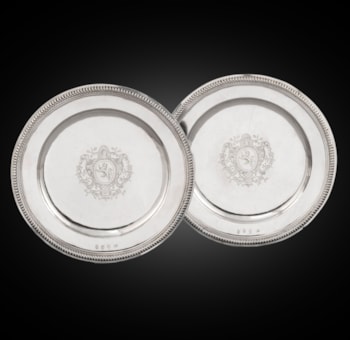
The Anson Plates


Paul de Lamerie
( 1688 - 1751 )
The Anson Plates

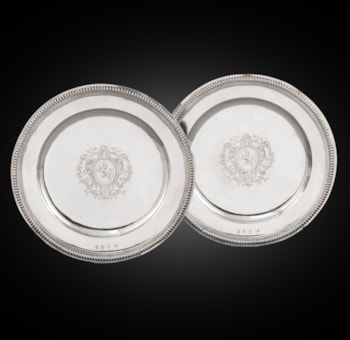
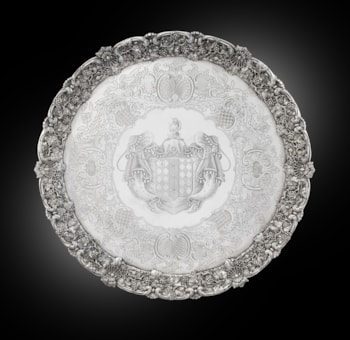
A Set of Twenty George II Silver-Gilt Plates
By Paul de Lamerie
London 1746/47
Diameter approximately 248mm.
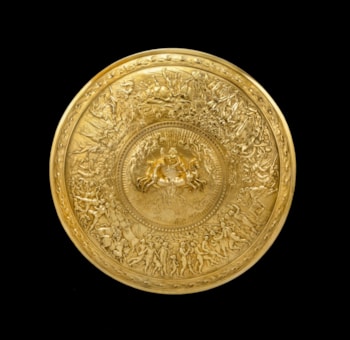
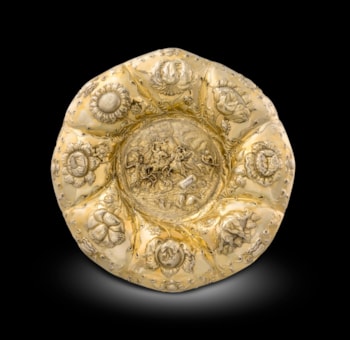
Each of circular form with five lobes, the borders with a reeded band framing, decorated with alternating shells and cherub heads, the rim ornamented with rocaille and crosshatched motifs, the centre engraved with coat of arms of Admiral George Anson (1697–1762).
Provenance
From the Collection of Gladys Moore Vanderbilt, Countess Széchényi (1886-1965)
George Anson (1697–1762) was a prominent British naval officer and later served as First Lord Anson of Shugborough, Baron of Soberton, co. Hants. He is best remembered for leading a circumnavigation of the globe (1740–1744) during the War of Jenkins' Ear, culminating in the capture of the Spanish treasure galleon Nuestra Señora de Covadonga. The extraordinary spoils of this expedition, valued at an estimated £500,000, were paraded through London in dozens of wagons.
Instrumental in strengthening Britain’s naval administration, Anson was also a prolific patron of silver, commissioning numerous works from Paul de Lamerie. These include the well-known 1726 ewer and basin and the 1747 ewer and cover, formerly in the collection of J. P. Morgan, with the former now in the Francis E. Fowler Museum, Los Angeles, as well as the present Lots 311 and 312. He died without heirs in 1762, but his legacy endured through these prestigious commissions.
Paul de Lamerie arrived in England with his Huguenot parents in or before 1689, having been baptized at 's Hertogenbosch in the Netherlands in 1688. In 1703 he was apprenticed to the Huguenot goldsmith Pierre Platel, and after being admitted to the freedom of the Goldsmiths' Company, he registered his first mark and set up a workshop in Windmill Street, Soho, in 1712. He took thirteen apprentices between 1715 and 1749 who paid premiums varying between £10 and £45m In 1716 he married Louisa Juliott, also a Huguenot, and by her had six children, three of whom died in childhood. Little more of his personal history is known, although his career in the Goldsmiths' Company is comparatively well documented. By 1717, he was already referred to as 'the King's Silversmith' but again in a complaint 'for making and selling Great quantities of Large Plate which he doth not bring to Goldsmith's Hall to be mark't according to Law.' He joined the livery in 1717; fourteen years later he was elected to the court of assistants. In 1743 he was appointed fourth warden and in 1747 second warden; that he never became prime warden probably due to ill health. From the outset he had wealthy clients such as the Honourable George Treby and the Duke of Sutherland. Among his more important later patrons were Sir Robert Walpole, Baron Anson, and the fifth Earl of Mountrath. A gradual expansion of his business culminated in his move in 1739 to considerably larger premises in Gerrard street. His pre-eminent position in the trade is signified by the commission he received in 1740 from the Goldsmiths' Company to provide two of their most splendid pieces of ceremonial display plate, a silver-gilt inkstand and the famous rococo ewer and dish.
You May Also Like

The Robert Troup Tray
Benjamin Smith II & James Smith III

Charles Anderson Pelham, 1st Baron Yarborough’s Tea & Coffee Service
Paul Storr

A George I Silver-Gilt Two-Handled Cup with Cover
Anthony Nelme

The Duke of York’s Tankards
Edward Farrell