
























Paul Storr
( 1771 - 1844 )
The Marquess of Tweeddale’s Serving Dishes


Paul Storr
( 1771 - 1844 )
The Marquess of Tweeddale’s Serving Dishes

A Set of Four Regency Meat Dishes
London, 1816
Maker’s mark of Paul Storr
Lengths: (the larger pair) 56.2 cm, 22.38 in and (the smaller pair) 47.4 cm, 18.63 in
Weight: 11,731 g, 377 oz. 4 dwt
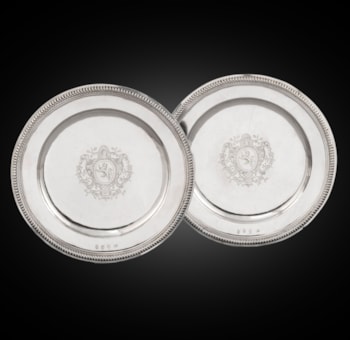
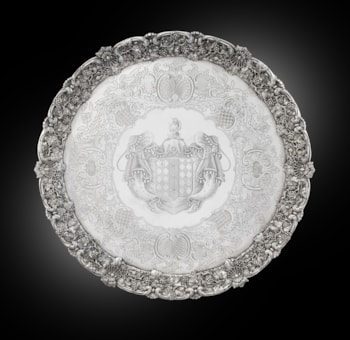
The graduated dishes all oval in form with gadrooned borders with double shells and acanthus at intervals. The dishes engraved twice with the full family blazon of arms below a marquess's coronet.
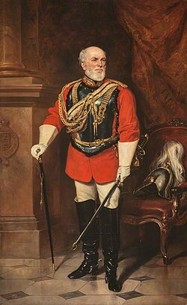
The arms are those of Hay impaling Montagu for George Hay, 8th Marquess of Tweeddale (1787-1876), and his wife Lady Susan Montagu (1801-1870), daughter of William Montagu, 5th Duke of Manchester, whom he married in 1816.
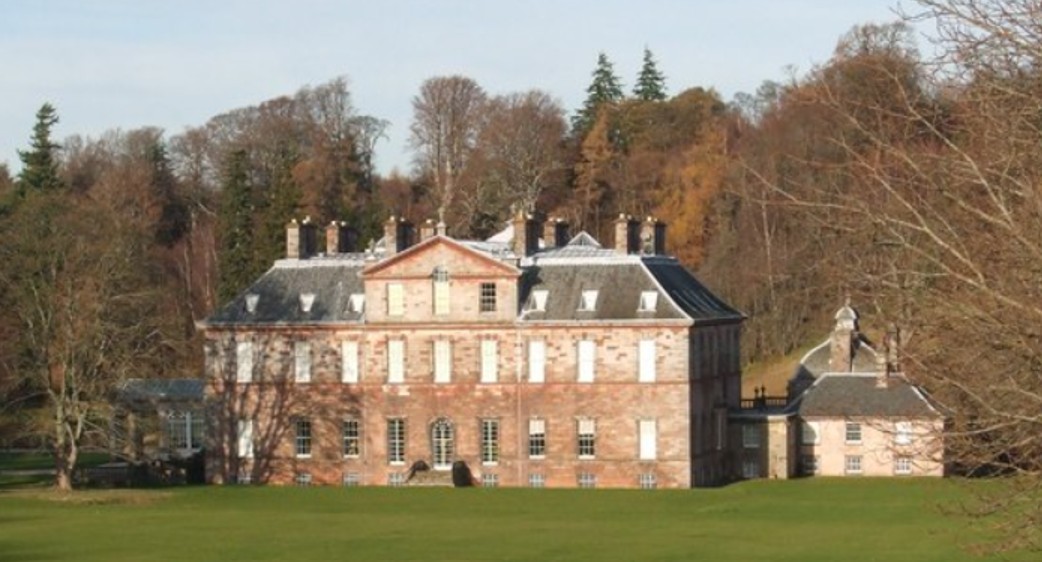
Born at Yester House the eldest son of George Hay, 7th Marquess of Tweeddale and Lady Hannah Charlotte Maitland (a daughter of James Maitland, 7th Earl of Lauderdale), Hay was educated at the Royal High School in Edinburgh and commissioned as an ensign in the 52nd Light Infantry in June 1804.[2] After succeeding to his father's title as Marquess of Tweeddale in August 1804, he was promoted to lieutenant on 12 October 1804 and, having received his first training under Sir John Moore at Shorncliffe,[3] he served as an aide-de-camp in Sicily in 1806.[4] He transferred to the Grenadier Guards with the rank of lieutenant in the regiment and captain in the Army on 12 May 1807.[4]
Hay served as a staff officer in the Peninsular War under Arthur Wellesley.[4] Hay was with Wellesley at the Second Battle of Porto in May 1809 when they crossed the Douro river in a daylight coup de main and routed Marshal Soult's French troops in Porto.[3] He was deputy assistant quartermaster general and was wounded at the Battle of Bussaco in September 1810 and, having been promoted to major in the 41st Regiment of Foot, he was assistant quartermaster general at the Battle of Vitoria in June 1813.[5] He was immediately promoted to lieutenant colonel.[4]
Hay also served in the War of 1812 between Britain and America, and commanded the 100th Regiment of Foot at the Battle of Chippawa in July 1814.[4] As the redcoats of the 1/1st (Royal Scots) Foot and 100th Regiments moved forward, their own artillery had to stop firing in order to avoid hitting them. Meanwhile, the American gunners switched from firing roundshot to firing canister, with lethal consequences for the British infantry. Once the opposing lines had closed to less than 100 yards apart, General Winfield Scott of the United States Army advanced his wings, forming his brigade into a "U" shape which allowed his flanking units to catch the British advancing troops in a heavy crossfire.[6] Hay made an attempt to fight to the death but was taken prisoner of war by the Americans.[4] He was appointed Companion of the Order of the Bath in 1815.[2] After the War he returned to Scotland and improved his family estate at Yester.[4] From 1818 to 1820 he served as Pro-Grand Master of the Grand Lodge of Scotland.[7] He was elected a representative peer for Scotland in July 1818, appointed Knight of the Thistle in 1820 and became Lord Lieutenant of East Lothian in February 1823.[8] He was also promoted to colonel on 27 May 1825[9] and to major-general on 10 May 1837.[10] Meanwhile, on his estate, he developed an improved method of making tiles for draining which was patented in October 1839.[11]
In 1842 Hay returned to public service when he was appointed governor of Madras and also, by special arrangement of the Duke of Wellington, Commander-in-Chief of the Madras Army.[2] In that role he restored the discipline of the army, which had been allowed to fall into a relaxed state.[3] Promoted to lieutenant general on 9 November 1846,[12] he retired from active service and returned to his estate in Scotland again in 1848.[4] He was promoted to full general on 20 June 1854[13] and invited to join a Royal Commission established in July 1858 to inquire into the organization of the army then serving under the East India Company.[14] He was advanced to Knight Commander of the Order of the Bath on 9 November 1862[15] and to Knight Grand Cross of the Order of the Bath on 13 March 1867[16] before being further promoted to field marshal on 29 May 1875.[17]
Hay also served as colonel of the 30th Regiment of Foot,[18] then of the 42nd Regiment of Foot[19] and finally of the 2nd Regiment of Life Guards.[20] A strong man, he once drove the mail coach from London to Haddington without a halt or a rest.[3] He died, following injuries sustained during a fire at his home,[3] at Yester House on 10 October 1876 and was buried in the family burial vault at the Church of St. Cuthbert at Yester in Scotland.
References:
Debrett, John (1847). Debrett's Genealogical Peerage of Great Britain and Ireland. William Pickering. p. 754.
"George Hay, 8th Marquess of Tweeddale". Oxford Dictionary of National Biography (online ed.). Oxford University Press. 2004. doi:10.1093/ref:odnb/12721. Retrieved 8 December 2013. (Subscription, Wikipedia Library access or UK public library membership required.)
"The Hays of Tweeddale". Electric Scotland. Retrieved 8 December 201
Heathcote, p. 173
"George Hay, 8th Marquess of Tweeddale". The Peerage. Retrieved 8 December 2013.
Elting, p. 186
"No. 17430". The London Gazette. 12 December 1818. p. 2224.
"No. 17898". The London Gazette. 22 February 1823. p. 292.
"No. 18141". The London Gazette. 28 May 1825. p. 927.
"No. 19456". The London Gazette. 10 January 1837. p. 64.
"No. 19783". The London Gazette. 29 October 1839. p. 2018.
"No. 20660". The London Gazette (Supplement). 10 November 1846. p. 3987.
"No. 21564". The London Gazette. 22 June 1854. p. 1932.
"No. 22162". The London Gazette. 16 July 1858. p. 3285.
"No. 22679". The London Gazette. 10 November 1862. p. 5343.
"No. 23230". The London Gazette. 15 March 1867. p. 1724.
"No. 24213". The London Gazette. 29 May 1875. p. 2851.
"No. 20571". The London Gazette. 13 February 1846. p. 529.
"No. 22610". The London Gazette. 21 March 1862. p. 1536.
"No. 22776". The London Gazette. 2 October 1863. p. 4742.
"George Hay, 8th Marquess of Tweeddale". Scottish War Memorials Project. Retrieved 8 December 2013.
George Hay, 8th Marquess of Tweeddale (1787-1876), and his wife Lady Susan Montagu (1801-1870).
Acquired by Matilda Geddings Gray (1885-1971) from Hammer Galleries, New York.
By descent to Matilda Gray Stream (1924-2023) and descendants.
Son of Thomas Storr of Westminster, first silver-chaser later innkeeper, born 1771. Apprenticed c'1785. Before his first partnership with William Frisbee in 1792 he worked at Church Street, Soho, which was the address of Andrew Fogelberg. This is also the address at which Storr's first separate mark is also entered. First mark entered as plateworker, in partnership with William Frisbee, 2 May 1792. Address: 5 Cock Lane, Snow Hill. Second mark alone, 12 January 1793. Address: 30 Church Street, Soho. Third mark, 27 April 1793. Fourth 8 August 1794. Moved to 20 Air Street, 8 October 1796, (where Thomas Pitts had worked till 1793). Fifth mark, 29 November 1799. Sixth, 21 August 1807. Address 53 Dean Street, Soho. Seventh, 10 February 1808. Ninth, 21 October 1813. Tenth, 12 September 1817. Moved to Harrison Street, Gray's Inn Road, 4 March 1819, after severing his connection with Rundell, Bridge and Rundell. Eleventh mark, 2 September 1883. Address: 17 Harrison Street. Twelfth and last mark, 2 September 1833. Heal records him in partnership with Frisbee and alone at Cock Lane in 1792, and at the other addresses and dates above, except Harrison Street. Storr married in 1801, Elizabeth Susanna Beyer of the Saxon family of piano and organ builders of Compton Street, by whom he had ten children. He retired in 1838, to live in Hill House in Tooting. He died 18 March 1844 and is buried in Tooting Churchyard. His will, proved 3 April 1844, shows an estate of £3000. A memorial to him in Otely Church, Suffolk was put up by his son Francis the then incumbent of the parish. For full details of Storr's relationship with Rundell, Bridge and Rundell please see N.M. Penzer, 1954 or Royal Goldsmiths, The Art of Rundell and Bridge, 2005.
Storr's reputation rests on his mastery of the grandoise neo-Classical style developed in the Regency period. His early pieces up to about 1800 show restrained taste, although by 1797 he had produced the remarkable gold font for the Duke of Portland. Here, however the modelling of the classical figures must presumably have been the work of a professional sculptor, as yet unidentified, and many of the pieces produced by him for Rundell and Bridge in the Royal Collection must have sprung from designs commissioned by that firm rather than from his own invention. On the other hand, they still existed in his Harrison Street workshop, until destroyed in World War II, a group of Piranesi engravings of classical vases and monuments bearing his signature, presumably used as source material for designs. The massiveness of the best of his compositions is well shown in the fine urn of 1800 at Woborn Abbey, but the Theocritus Cup in the Royal Collection must be essentially ascribed to the restraint of its designer John Flaxman, while not denying to Storr its superb execution. Lord Spencer's ice pails of 1817 show similar quality. Not all Storr's work however was of classical inspiration. The candelabra of 1807 at Woburn derive from candlesticks by Paul Crespin of the George II period, formerly part of the Bedford Collection, and he attempted essays in floral rococo design from time to time, which tend to over-floridity. On occasions the excellence of his technical qualities was marred by a lack of good proportions, as in the chalices of the church plate of St Pancras, 1821. In spite of these small lapses there is no doubt that Storr rose to the demands made upon him as the author of more fine display plate than any other English goldsmith, including Paul De Lamerie, was ever called upon to produce.
You May Also Like
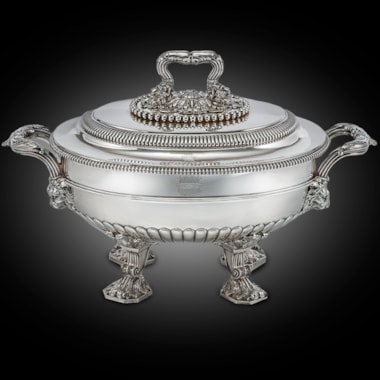
An Outstanding Paul Storr Soup Tureen
Paul Storr
A Fine Chocolate Pot
Fuller White
A Monumental Basket Centrepiece
Goldsmiths & Silversmiths Co Ltd
An Edwardian Heart-Shaped Clock