
























George Wickes
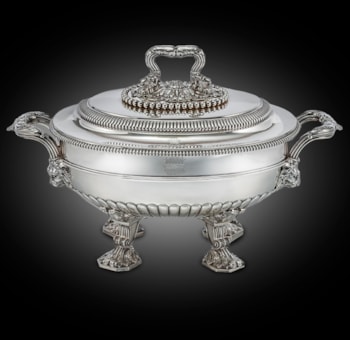
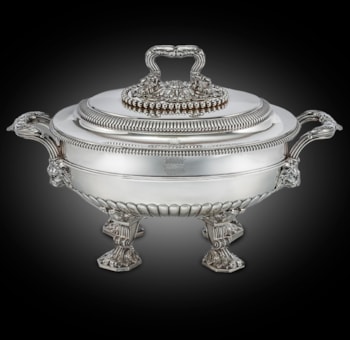
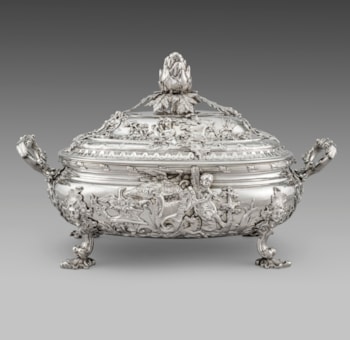
An Important George II Soup Tureen

George Wickes
An Important George II Soup Tureen

Maker’s mark of George Wickes
London 1737
Length: 42 cm (18 ½ inches) Weight: 4,035 g (129.7 oz)
On four lion-mask and claw and ball capped feet, the handles cast as the crest of Fane (a bull's head), the body applied with cast armorials of Fane and Rowe within rococo cartouches, the stepped and domed lid with cast and applied the crests of Fane in rococo cartouches and classical heads within rococo shell and foliate decoration on textured backgrounds, the cast scroll handle with highly stylised lion mask, paw and leaf decoration, fully hallmarked on the lid and body.
The arms are those of Henry Fane of Wormsley, Watlington, Oxon., MP for Lyme Regis (1757-1777) and his first wife (17 July 1735) Charlotte, daughter of Nicholas Rowe, the celebrated poet and dramatist (born 1674) who was buried in Westminster Abbey in 1718. Nicholas Rowe held an appointment of Clerk of Presentations to Thomas Parker, Earl of Macclesfield. Charlotte bore one child but died on 29 Sept 1739, and on 20 May 1742 Henry Fane married Ann Wynn, daughter of the Bishop of Bath and Wells. Ann bore one daughter and disappears from the record. In 1748 Henry Fane married Charlotte, daughter and co-heir (with her sister, Rebecca Taylor) of John Luther of Myles's, Essex.
The Garrard Ledgers in The Victoria & Albert Museum Archives Library show the following entry in George Wickes' accounts: 'Henry Fane August 4th 1737 'Turreen & cover' (sic) 131ozs .10; cost £55.0s.0d.'. The accounts state that Henry Fane paid for the tureen August 20th 1737, in cash the sum of £57. 15s., which included other work carried out.
The castings of the handles on this tureen had been used by Wickes on an earlier tureen for Lord North in 1735. Another tureen, made for Frederick, Prince of Wales in 1743, employed the same cast handle and lion masks and paw feet. Similar handle and feet castings were later used by Paul de Lamerie on a tureen of 1751.
Barr, E. 'George Wickes', Studio Vista/Christie's, 1980, p 123, 151 and 154 for illustrations of the tureens made by Wickes for Lord North and Frederick, Prince Of Wales.
Son of James Wickes late of St.Edmondsbury in the county of Suffolk upholsterer deceased, apprenticed to Samuel Wastell 2 December 1712 on payment of £30 (he signs Wicks). Free, 16 June 1720. Two marks (Sterling and New Standard) entered as largeworker, 3 February 1722. Address: Threadneedle Street. Third mark, 30 June 1735. Address: Panton Street, Haymarket. Livery, March 1739/40. Fourth Mark, 6 July 1739. Address: ‘at the King’s Arms, Panton Street near the Haymarket.’ More, however, is known of his working life than revealed in his mark entries. Heal records him as a plateworker, Leadenhall Street, before 1721, when he was presumable still working with Wastell, who was there at least 1705-8 (Heal). By c. 1730 he was in partnership with John Craig (see Ann Craig) at the corner of Norris Street, Haymarket, almost opposite his final situation. There is no recorded mark for this partnership, but a supporting fact to its existence is the apprenticeship to Wickes in 1731 of David Craig. Heal records the death of John Craig in 1735 or 1736, the former year that in which Wickes entered his Panton Street marks and it is clear from the surviving ledger (Messrs Garrard’s) that this is when Wickes began a really independent existence. The Panton Street mark was entered on 30 June and the ledger’s first entry is dated the 23rd of the same month. One folio (31) of the ledger is headed ‘My House’ and under 24 June appears the entry ‘To the King’s Arms and Feathers £14.3.6’, providing a terminus a quo for the Wickes appointment to Frederick, Prince of Wales, who was later to cause him considerable trouble. Heal records him as King’s Arms, Panton Street, two doors from Haymarket, 1735-61; and in partnership with Samuel Netherton as goldsmiths and jewellers, at the same address, 1751, left off business 1759. There is no mark for this partnership, and as will be seen below, it would seem as though Wickes renounced the silversmith’s side of the business to Edward Wakelin (q.v.) in 1747 and remained a sleeping partner with Netherton attending to the jewellery side. With the growth of the business by this time, as witnessed by the list of distinguished clients in the ledgers, there must have been of necessity a division of responsibility. The first ledger, which runs from 1735 to 1741, contains, among others, accounts for the Dukes of Devonshire and Chandos, Dowager Duchess of Norfolk, Marquess of Caernarvon, Earl Inchiquin and many ‘Lords’. In the next volume he added the Dukes of Kingston, Roxburgh, Montrose and Bridgwater, the Earls of Scarborough, Kildare and others, Admiral Vernon and Arthur Onslow, the Speaker. Bishops appear from time to time to add dignity to the list.
The account of Frederick, Prince of Wales commences on 24 March 1735/6 with a tactful gesture, ‘To a Black Eboney Handle for a tea kettle and a Button for a teapot os.od.’ The next entries set a more realistic standard ‘May 1. To a fine cup & cover 124 oz 17 d. £80. To a fine Bread Baskett 87 oz 9 d. £50’. There are several entries for the hire of plate for parties in November, December, January and August, the last ‘To the use of Plate for ye Oxford & Cambridge entertainment £6.6.0’. Frederick had been living at an extravagant rate and in September 1737 he was banished by George II to cool his heels at Kew and made attempts to retrench. ‘The Prince reduced the number of his inferior servants which made many enemies among the lower sort of people and did not save him money. He put off all his horses too that were not absolutely necessary and farmed all his tables, even that of the Princess and himself.’ (i.e. contracted his catering) (Hervey’s Memoirs). The blow fell, too, on Wickes who entered in his ledger: ‘ September 20 To the Damadge and Loss to me in a Large Parcell of Plate Bespoke and ordered by the Prince which was in such forwardness when counterdemand(ed) as amounts to more than £500.’ Later Wickes allows in credit ‘Sold Six Dozen of Plates and twelve Dishes at 6d per oz 2000 oz. £50’, obviously the charge for the plate tax, which he seems already to have charged his royal client. Then he cooled off and added ‘The Damadge on the other side (i.e. debit account) being Reduced by executing part of the work intended and I have now taken of token of the whole Damadge altho’ I have not Recd it any other wise than by the profit of the work made…£450’, thus writing off the matter. However, by February 1738 he had a new order from the Prince for ’18 chased Sconces weighing 426 oz at 5/11 per oz. £126.1.6 plus £5.5. for making each’, and from here the royal account returned to a satisfactory conduct. The most important piece recognizable in the account is the silver-gilt epergne designed by William Kent, and still, though added to by Rundell and Bridge, in the Royal Collection: ‘Nov.11.1745 To a silver gilt Epergne, a Table, 4 Saucers, 4 Casters, 8 Branch lights and Pegs 845 oz.9d. at 15/8 per oz £662.5.4 To Graving the Table 4 Saucers and Casters £23.16.0. To 6 Glass Saucers £3.3.0 To 2 Wainscot Cases £6.10.0.’ After the Prince’s death Wickes continued to work for his widow and in 1759 a modest account starts for ‘Their Royal Highnesses Prince William and Henry’, the third and fourth sons of Frederick, then only sixteen and fourteen years old.
The largest of Wicke’s productions for one client to have survived intact would seem to be the service of 1745-47 made for James Fitzgerald, Viscount Leinster, subsequently Duke of Leinster, on his marriage to Emilia, daughter of the 2nd Duke of Richmond. This numbers some one hundred and seventy pieces, including an arbour epergne (Collection Walter Chrysler Jr., Parke-Benet, New York, 1960).
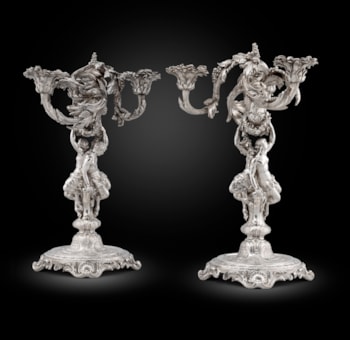
Other outstanding pieces are the ewer and dish of 1735 formerly in the collection (Jackson, History of English Plate), a group of gilt dishes made for Frederick, Prince of Wales, 1739 now dispersed (Sterling Clark Institute, Williamstown, Mass., the late Sir Philip Sassoon and others), and a pair of candelabra with nymph and faun figures of 1744 made for the Earl of Kildare (Christie’s 1926).
There is little doubt that from 1735 onwards Wickes’ clientele was as large and important as (if not possibly more so than) Lamerie’s and the quality of his productions, whoever the executants, in no way inferior to the latter’s.
You May Also Like

The Duke of Roxburghe’s Candlesticks
Thomas Heming

1st Earl of Clanbrassil and Viscount Limerick’s Epergne
Eliza(beth) Godfrey

A Set of Four George II Silver Candlesticks
William Kidney

A George III gold mounted and carved mocha agate snuff box